Here's the problem: too many buyers pick a flange by nominal size and price alone. That shortcut can leave you with a bore that doesn't match the pipe schedule, a material grade that's wrong for the service temperature, a pressure class that doesn't fit the rest of the system, or a weld prep that slows down fabrication.
This guide covers how weld neck flanges are built, why carbon steel is a practical material choice, where these flanges typically get used, how to select and specify one correctly, how they compare to long weld neck flanges, and where to source them.
Key Takeaways
- The tapered hub and butt-weld joint spread stress along a longer transition, not at one point.
- Carbon steel (A105 or A350) balances strength, weldability, and cost when the grade matches service conditions.
- Size alone won't get the right flange: pressure class, schedule, facing, and material standard must all line up.
- Confirm code requirements, then line up compatible bolting, gaskets, and documentation before ordering.
What Is a Carbon Steel Weld Neck Flange?
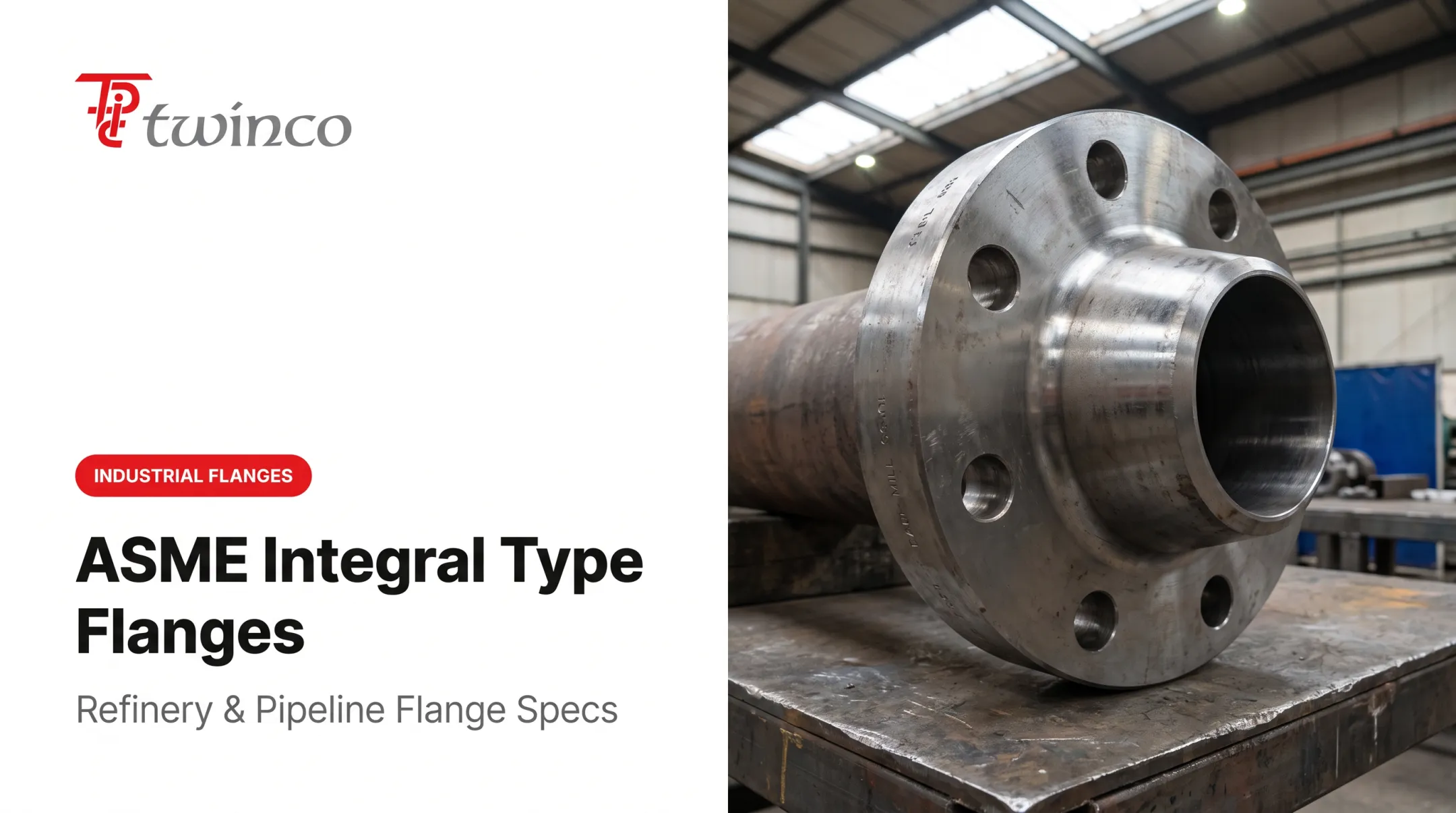
A carbon steel weld neck flange is a flanged piping component with a long, tapered hub that's joined to the pipe with a full-penetration circumferential butt weld. That tapered hub is the defining feature. It creates a gradual transition between the thick flange body and the thinner pipe wall instead of an abrupt step.
That gradual transition spreads stress from internal pressure, bending loads, vibration, and thermal expansion across a longer section of metal rather than concentrating it at the weld. That's why weld neck flanges show up so often in services where fatigue or cyclic loading is a genuine concern.

Key Physical Features to Identify
When you're reviewing a weld neck flange drawing or holding the physical part, you should be able to point to:
- Outside diameter (OD) — the overall flange dimension
- Bolt circle — the diameter on which bolt holes are centered
- Bolt holes — sized and spaced per the governing standard
- Bore — the inside opening, which must match the pipe's ID and schedule
- Flange face — the sealing surface (raised face, flat face, or ring-type joint)
- Hub and neck — the tapered transition zone
- Weld-preparation area — the beveled end ready for butt-welding
Bore matching isn't optional. The flange bore, hub taper, and pipe wall thickness all need to align with the pipe's outside diameter and schedule. Get it wrong, and you create an internal step that disrupts flow and complicates the weld.
How It Compares to Other Flange Types
Weld neck isn't the only connection method available:
- Slip-on — pipe slides into the bore, then it's fillet-welded inside and out; simpler fit-up, lower cost
- Threaded — screwed onto pipe threads with no welding, limited to lower-pressure, non-critical service
- Socket weld — pipe inserts into a socket and gets fillet-welded; common on smaller-bore, higher-pressure lines
- Blind — no bore at all, used to cap or isolate a line
None of these automatically outrank the others. The connection method should match the service conditions your project actually calls for.
"Carbon steel" isn't a single material. It's a family of grades with different chemistry, heat treatment, and mechanical properties, so confirm what the project specification calls for before assuming a grade.
Flange dimensions and pressure classes are governed by ASME B16.5 for NPS ½ through NPS 24 (classes 150 through 2500), with ASME B16.47 covering larger diameters.
Why Choose Carbon Steel for a Weld Neck Flange?
Carbon steel earns its place in industrial piping for practical reasons, not tradition.
It offers solid mechanical strength, wide availability, easy machinability, and a lower cost than stainless or exotic alloys — a combination that covers a large share of oil, gas, petrochemical, utility, fabrication, and infrastructure work.
Weldability Comes With Conditions
Carbon steel welds well, but that's not a blank check. Before fabrication, confirm:
- The exact grade and its carbon-equivalent value
- Whether preheat or post-weld heat treatment applies
- That the welding procedure is qualified for that grade, thickness, and service
ASTM A105 covers forged carbon steel for piping components, including flanges, in ambient and higher-temperature service, with required heat treatment, tension and hardness testing, and product marking. That's the workhorse spec for ordinary process and utility conditions.
Low-temperature service typically shifts to ASTM A350 grades, which add notch-toughness testing that A105 doesn't require.
When Carbon Steel Needs a Second Look
Carbon steel isn't automatically right for every environment. Reconsider it, or plan for protective measures, in:
- Wet or highly oxygenated service
- Corrosive or chemically aggressive fluids
- Sour service (H2S-containing streams)
- Cryogenic temperatures
Sour service is a good example of why material assumptions get expensive. ANSI/NACE MR0175/ISO 15156 governs how carbon and low-alloy steels get qualified for H2S-containing oil and gas equipment. That's a separate qualification step, not something A105 automatically satisfies.
Pressure Class and Temperature Move Together
Here's a mistake worth avoiding: treating pressure class and temperature as separate decisions. A flange's allowable pressure drops as temperature climbs, so a class that's fine at 100°F might not hold at 500°F.
Check both against the governing pressure-temperature table before locking in a spec.

Carbon Steel vs. Stainless or Alloy Steel
| Factor | Carbon Steel | Stainless/Alloy Steel |
|---|---|---|
| Cost | Lower | Higher |
| Availability | Broad | More limited, longer lead times |
| Corrosion resistance | Limited without protection | Better in corrosive/sour service |
| Temperature range | Ambient to moderate | Wider, including cryogenic and high-temp grades |
The right call always comes back to matching the flange material to the connected pipe and the actual process fluid. Don't default to whatever's cheapest or most familiar on the shelf.
Where Are Carbon Steel Weld Neck Flanges Used?
Carbon steel weld neck flanges are used wherever a piping system needs a mechanically robust, butt-welded connection. Typical applications include:
- Pipeline construction and process piping: Connect lines, valves, pumps, separators, and equipment where a full-penetration weld is specified over a lighter-duty joint
- Refineries, petrochemical plants, and chemical processing: Meet pressure, temperature, hazardous-media, and leak-prevention demands at process facilities and storage terminals
- Power generation and industrial utility systems: Serve steam, feedwater, fuel, cooling, and auxiliary lines, each with its own material and pressure requirements
- Maintenance, shutdowns, and hydrostatic testing: Match existing pipe dimensions, facing, pressure class, and material documentation exactly during turnarounds
Critical vs. Non-Critical Service
A high-pressure, cyclic-load process line and a low-pressure utility line don't need the same scrutiny. Both still need a flange that matches the governing design code, such as ASME B31.3, and the owner's specification.
Lower pressure doesn't mean you skip the verification step. The applicable code still decides what's acceptable.
How to Select, Specify, and Install a Carbon Steel Weld Neck Flange
Build a Specification Checklist
Before requesting a quote, confirm:
- Nominal pipe size (NPS) and pipe schedule or wall thickness
- Flange pressure class (150 through 2500)
- Dimensional standard (ASME B16.5 for smaller sizes; B16.47 for larger)
- Carbon steel grade and flange facing (RF, FF, or RTJ)
- Bore matched to the pipe OD and wall
- Quantity, service temperature, and required documentation (such as MTRs)
Skip any one of these fields, and a "matching" flange can arrive wrong.
Match the Facing to the Joint
Three facing types cover most projects:
- Raised face (RF): most common; raised sealing surface for standard gaskets
- Flat face (FF): flush face; often paired with cast iron or low-pressure equipment
- Ring-type joint (RTJ): grooved for a metal ring gasket in higher-pressure or high-temperature service
The facing must match the mating flange, gasket, and bolt-up method. Mixing facings is a fast way to end up with a joint that will not seal.
Give Your Supplier the Full Picture
Handing over a size and class is not enough. Share the process medium, design pressure and temperature, corrosion conditions, cyclic loading or vibration exposure, and the applicable piping code. That context lets a supplier confirm the flange fits the service, not just the pipe. Suppliers such as Twinco Industrial can also align matching gaskets, studs, and nuts from the same bill of materials so the bolted joint ships complete.
Get the Bore Right
A wrong bore or pipe-wall mismatch creates an internal step at the weld, which disrupts flow, complicates weld prep, and can cause fit-up problems on site. Confirm the bore against the pipe's actual outside diameter and wall thickness, not just its nominal label.

Treat It as a Complete Bolted Joint
A flange doesn't work alone. Line up:
- Compatible gaskets — spiral wound, RTJ, or compressed fiber, depending on service
- Studs, bolts, and nuts rated for the pressure class and temperature
- Matching valves, pipe, fittings, and equipment nozzles
When you place the order, reconfirm delivery timing and documentation needs (MTRs, heat numbers, and any project-specific certs) against the spec checklist above.
Installation and Fit-Up
Once the flange arrives, installation quality matters as much as the spec sheet. Use qualified welders working to an approved WPS suited to the carbon steel grade, pipe material, thickness, and service. Watch for:
- Flange alignment and bolt-hole orientation before tack-up
- Correct root gap and bevel preparation
- Protection of the serrated flange face from spatter and handling damage
- Distortion control during welding and controlled bolt-up after fit-up
Quality Documentation and Common Mistakes
Verify MTRs, dimensional checks, visual inspection, NDE results, heat treatment records, and heat-number traceability before the flange goes into the line.
Common errors that cause delays include:
- Mixing pressure classes on the same joint
- Pairing incompatible flange faces
- Using the wrong bore for the pipe schedule
- Damaging the gasket seating surface
- Substituting a material grade without engineering approval
Carbon Steel Weld Neck Flanges Compared With Long Weld Neck Flanges
A long weld neck (LWN) flange looks like a standard weld neck's taller cousin. It has an extended hub built for specialized equipment, vessel, or nozzle arrangements where extra length or reinforcement is required.
| Comparison Point | Standard Weld Neck | Long Weld Neck |
|---|---|---|
| Hub length | Moderate, tapered | Extended |
| Typical use | Inline pipe connection | Vessel or nozzle connection |
| Installation space | Standard | Requires more room for the hub |
| Reinforcement | Built into the taper | Often part of the vessel's nozzle design |
Here's the catch: a longer neck doesn't automatically mean higher pressure or temperature capability. Rating, material, dimensions, and design-code requirements still control what the flange can handle — length alone changes nothing about the pressure-temperature rating.
If a project drawing, equipment manufacturer, or engineering specification calls for a long weld neck, don't substitute a standard weld neck because it looks close enough. Swapping one for the other without engineering sign-off creates a design problem, not just a paperwork one.
Sourcing Carbon Steel Weld Neck Flanges
Finding the exact carbon steel weld neck flange your project needs, in the right size, class, and grade, isn't always straightforward. An experienced industrial supplier can verify specifications, track down hard-to-find sizes, and coordinate the bolting and gaskets that complete the joint.
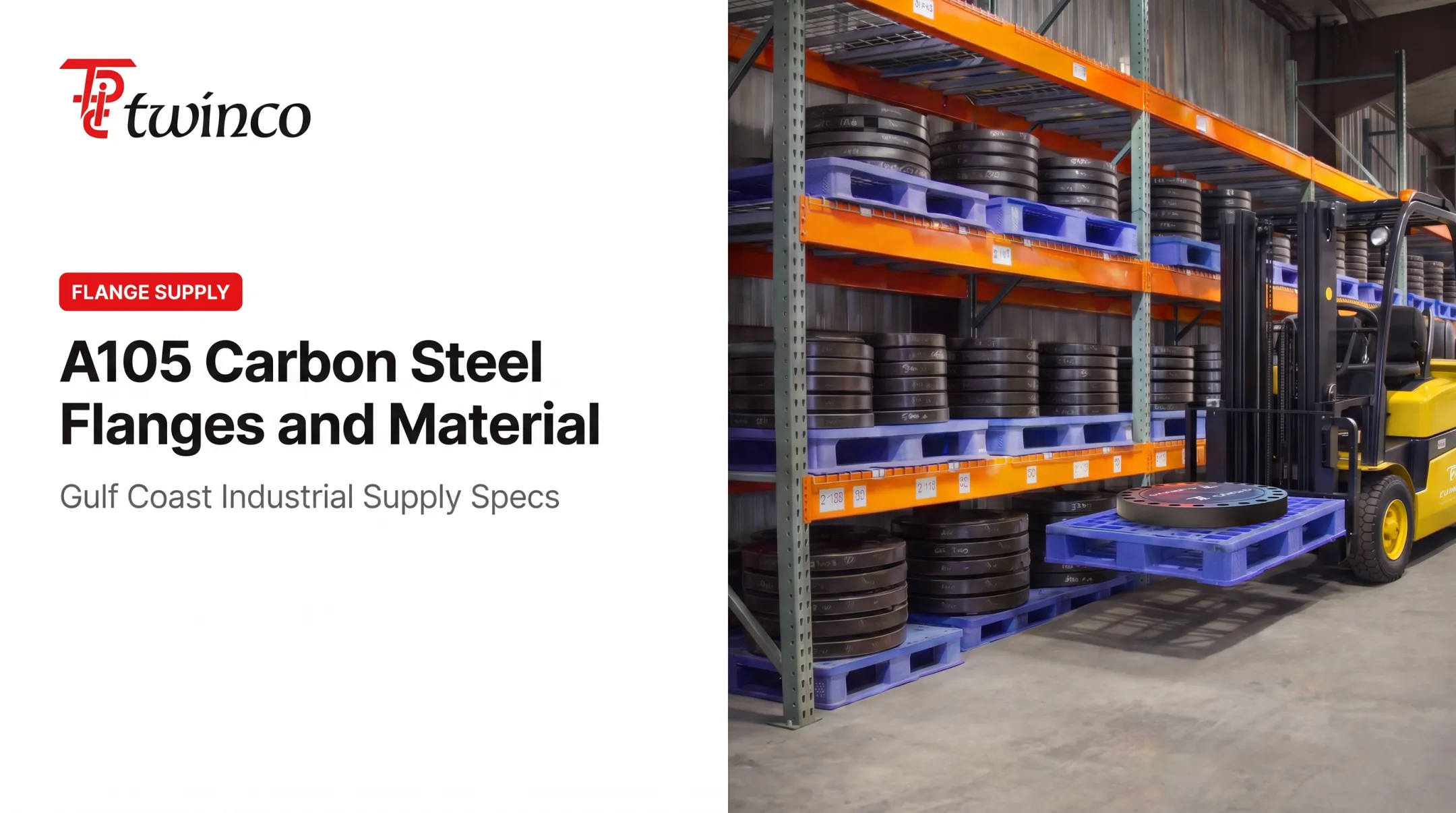
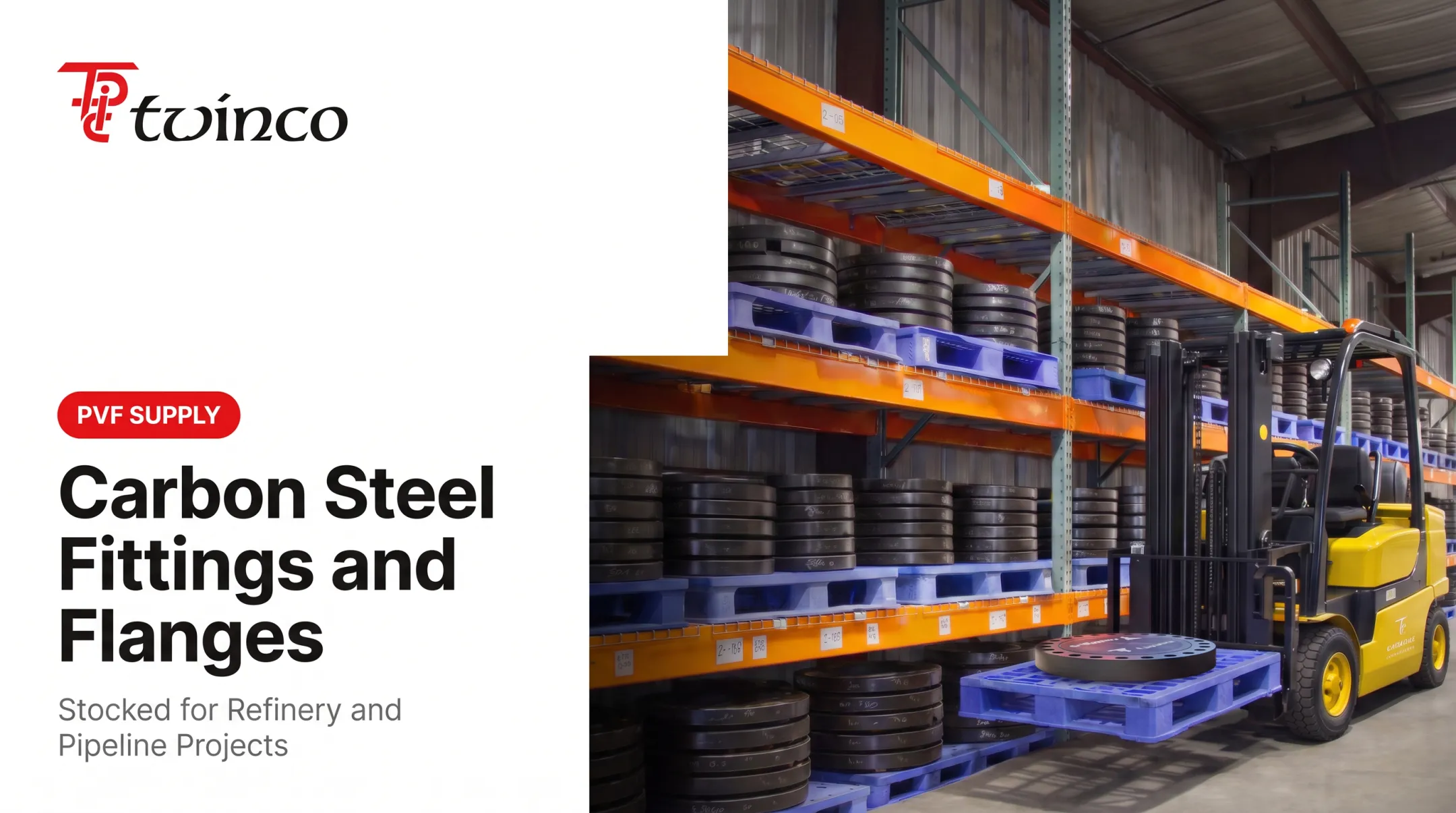
Twinco Industrial has supplied industrial piping components since 1977, operating out of Houston with shipping across the USA, Canada, and Mexico. Flange inventory covers ½ inch through 72 inches, ASME pressure classes 150 through 2500, in carbon steel, stainless steel, and specialty alloys.

That range supports projects where weld neck flanges typically get specified:
- Pipeline construction and commissioning
- Petrochemical and refinery turnarounds
- Hydrostatic testing programs
- Industrial construction and maintenance work
Twinco also offers domestic (USA) and import sourcing options. Rent-or-buy flexibility on blind flanges and bolting matters when a project only needs equipment for a defined testing or maintenance window.
What to Have Ready When You Call
Before reaching out, gather:
- Flange size and pressure class
- Material grade
- Facing
- Bore or pipe schedule
- Quantity, delivery location, and documentation requirements
With those details, Twinco's sales team can confirm availability and fit. Contact Twinco Industrial for a quote on weld neck flanges, gaskets, bolting, and the other components your bolted joint needs.
Frequently Asked Questions
When should you use a weld neck flange?
Use weld neck flanges for high-pressure, high-temperature, cyclic, vibrating, or other critical service where a full-penetration butt weld is preferred. Always confirm the choice against the applicable piping code and project specification.
What is the difference between a long weld neck flange and a weld neck flange?
A long weld neck flange has an extended hub built for vessel or nozzle connections, while a standard weld neck flange is sized for inline pipe connections. The equipment or piping specification should dictate which type your project requires.
Can carbon steel weld neck flanges be welded?
Yes. Carbon steel weld neck flanges are designed for butt-welding to matching pipe. Confirm grade, pipe material, WPS, preheat, and inspection requirements before fabrication.
What are carbon steel weld neck flanges used for?
They're used in process piping, pipelines, refineries, petrochemical plants, power generation, and industrial construction that need a permanent welded flange joint.
What information is needed to order a carbon steel weld neck flange?
Have these details ready when you request a quote:
- Nominal size, pipe schedule or bore, and pressure class
- Material grade, facing, and dimensional standard
- Quantity, service conditions, and delivery timing
- Documentation needs such as MTRs