Introduction
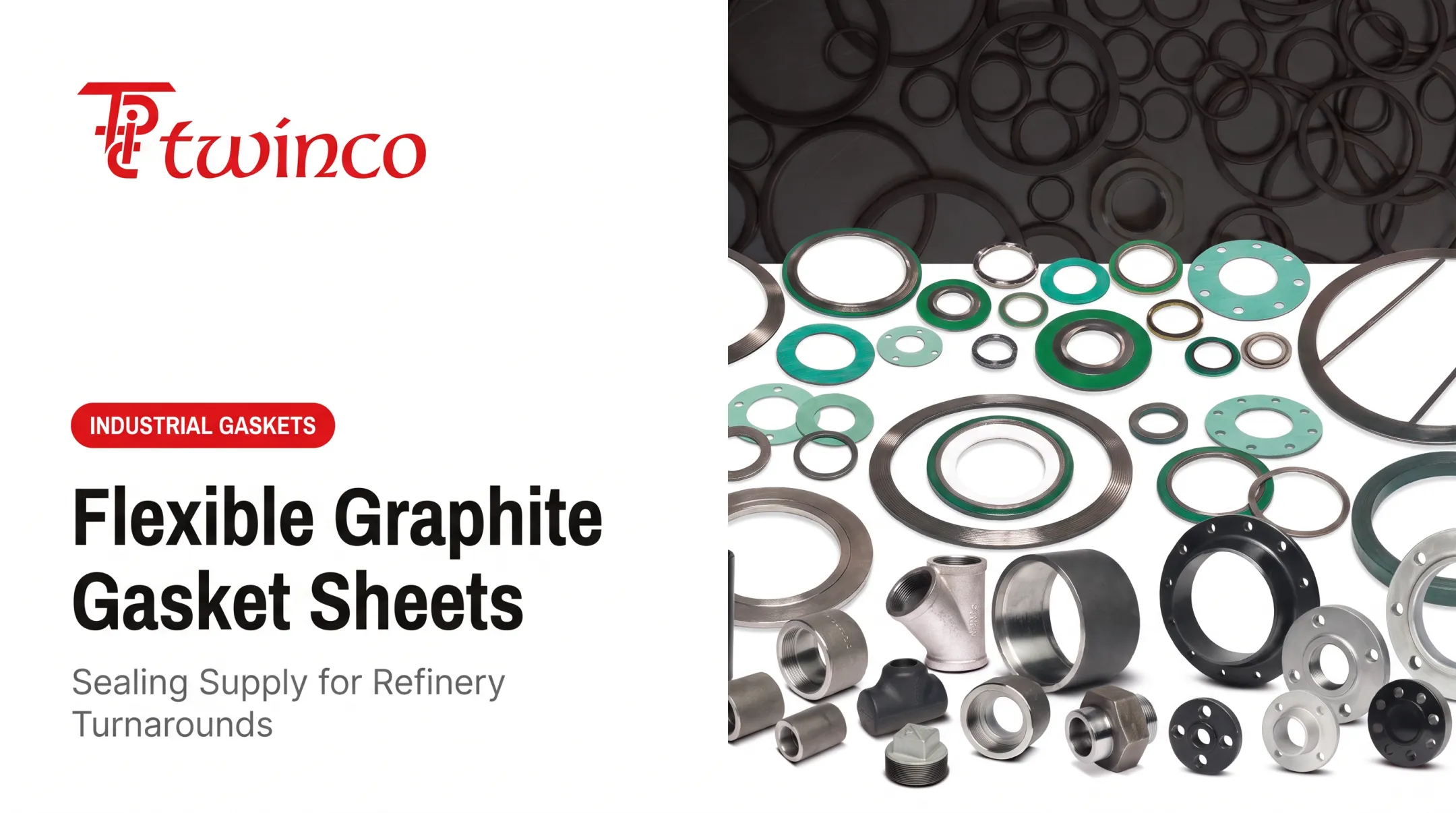
"Metallic graphite gasket" is a confusing term. Graphite is not a metal, and a gasket described this way is not made from metallic graphite as a single material. It's flexible graphite paired with a metal reinforcement, such as a foil layer, wire mesh, or a tanged carrier that anchors the graphite in place.
That build is what plant and pipeline teams need when conditions get harsh. Piping, refinery, power, and pressure-testing systems all struggle with the same issue: flanges are rarely perfectly flat, and the gasket still has to seal. It also has to handle heat, pressure swings, and whatever chemical is running through the line.
This guide covers how these gaskets are built, what they can and can't do, how to select the right one, and where to source them for a US industrial project.
Key Takeaways
- Metal reinforcement gives graphite gaskets the strength and creep resistance needed for demanding flange service
- Match the gasket to temperature, pressure, media, oxidation risk, and flange condition—not brand alone
- Graphite gaskets are not interchangeable; construction and specs differ by manufacturer
- Oxidation and chemical attack are the failure modes most likely to cut service life short
What Are Metallic Graphite Gaskets?
Flexible graphite is a carbon-based, nonmetallic sealing material. Manufacturers produce it from purified natural graphite flakes that are chemically treated, expanded with heat, and compressed into foil or sheet form, typically without adhesives or binders.
So where does "metallic" come in? In gasket terminology, it refers to how the graphite is reinforced, not what the graphite itself is made of. Common approaches include:
- Tanged metal cores — a thin perforated metal sheet (often 316 stainless steel) that mechanically locks the graphite in place
- Wire mesh inserts — embedded within the graphite for added tensile strength
- Metal foil laminates — bonded to one or both faces of the graphite sheet
- Multilayer stainless inserts — used in heavier-duty sheet constructions
Why Manufacturers Add Reinforcement
Homogeneous graphite sheet can tear or deform during handling and installation, especially on larger flanges. Adding a metal insert improves tensile strength, keeps the gasket dimensionally stable during cutting and bolt-up, and reduces long-term creep under sustained load. This makes reinforced graphite more suitable for bigger flanges and higher-stress joints.
Construction isn't standardized across brands. One manufacturer's tanged-core sheet may perform very differently from another's foil-laminate version. Always verify the exact build with the manufacturer's data sheet rather than assuming two "graphite" products behave the same way.
How This Differs From Other Gasket Types
Metallic graphite sheet gaskets are not the same as spiral-wound or Kammprofile gaskets, even though both can use graphite. A Kammprofile gasket uses a solid, serrated metal core with a soft facing bonded to each side. The core supplies rigidity and blowout resistance; the graphite facing does the actual sealing.
In a flat metallic graphite sheet, the metal insert only reinforces the graphite body—it does not replace it as the sealing element. Graphite's layered carbon structure is naturally slippery and conformable, so under compression it flows into small surface scratches and irregularities that a rigid metal gasket could never seal against.

Properties, Benefits, and Limitations
Flexible graphite's key properties are compressibility, conformability, low permeability, and broad chemical resistance. It handles high temperatures well when the grade and environment are within its rated range.
One manufacturer's tanged-core sheet gasket reports 35% compressibility and 18% recovery at 5,000 psi, with 10% creep relaxation under stated test conditions. Numbers like these vary by brand and construction, so treat them as reference points, not universal specs.
What Reinforcement Trades Away
Adding metal improves strength and creep resistance, but it comes at a cost:
- Reduced overall flexibility compared to homogeneous graphite sheet
- Lower recovery after compression in some designs
- Less conformability on badly damaged or pitted flange faces
Oxidation Is the Real Limiting Factor
Oxidation is where graphite gaskets most often run into trouble. In oxygen-rich environments at elevated temperature, graphite loses mass over time, which reduces flange load and eventually leads to leakage.
The Fluid Sealing Association notes that oxidation rate depends on temperature, oxygen exposure, purity, contaminants, and exposed surface area. That means there's no single "safe" temperature for every application. Always check the manufacturer's rated limits for your specific atmosphere.
When Graphite Isn't the Right Call
A few scenarios call for a different material entirely:
- High-purity or ultra-clean systems where graphite particulate contamination is unacceptable
- Highly oxidizing acid service outside the gasket's chemical resistance range
- Regulatory or specification requirements that mandate a different sealing material
Metallic graphite vs. the alternatives:
- Spiral-wound gaskets handle pressure cycling better in some services
- PTFE suits corrosive or high-purity lines
- Elastomeric gaskets work for lower-temperature general service
- Solid-metal or ceramic gaskets fit extreme-temperature or extreme-pressure niches
The right choice depends on operating envelope, flange condition, and how long the joint needs to last between turnarounds.
How to Select the Right Metallic Graphite Gasket
Start with the service conditions, not the catalog page.
- Nail down the operating conditions
- Media: what's actually flowing through the line, including trace contaminants
- Temperature range: minimum and maximum, plus whether cycling occurs
- Pressure: steady-state and any cyclic or vacuum conditions
- Atmosphere: oxidizing, reducing, or inert, since this drives your oxidation risk
- Match the gasket to the flange
Confirm the nominal pipe size, pressure class, flange facing type, gasket seating area, and surface condition before ordering. A gasket cut to the wrong bolt circle or facing type won't seal, no matter how good the material is.
- Evaluate the reinforcement itself
Ask about the insert's material, thickness, corrosion resistance, and temperature rating. A carbon steel tanged core in a corrosive system creates a weak point the graphite alone never would.
- Confirm documentation
Request the graphite grade, dimensional tolerances, manufacturer data sheets, and material certificates. For traceable or project-specified work, this documentation isn't optional.
- Don't guess on bolt loading
Torque and seating-stress requirements are gasket- and flange-specific. Follow the gasket manufacturer's installation instructions and the applicable flange standard rather than reusing a generic torque number from a different job.

Quick buyer's checklist:
- Gasket type and construction (tanged core, foil, mesh)
- Dimensions and flange facing
- Pressure class and temperature range
- Media and atmosphere
- Reinforcement material and rating
- Quantity, delivery timeline, and spares
Applications, Installation, and Procurement
Metallic graphite gaskets serve a wide range of industrial services. Suitability still depends on pressure, temperature, and media:
- Refinery and petrochemical piping
- Steam and process systems
- Valves, pumps, and heat-transfer equipment
- Power plant maintenance
- Pipeline construction and tie-ins
- Pressure testing and shutdown/turnaround work
Installation Basics That Prevent Leaks
- Clean and inspect flange faces. Remove debris, old gasket material, and check for gouges or warping.
- Confirm alignment before setting the gasket.
- Use the correct gasket size and orientation as specified for the joint.
- Follow the approved bolting sequence. Tighten in a cross-pattern, in stages, up to final torque.
- Never reuse a compressed gasket unless the manufacturer explicitly designs it for reuse.
Common Failure Causes
Most premature gasket failures trace back to a handful of repeat offenders:
- Wrong dimensions or facing type for the flange
- Damaged or pitted flange faces
- Uneven bolt loading during assembly
- Excessive compression or insufficient seating stress
- Media incompatibility or unexpected oxidation exposure
- Reinforcement material that doesn't match the service environment
Document the installed gasket's material, size, construction, and service conditions after every job. It sounds like extra paperwork in the moment, but it saves real time during the next turnaround or emergency replacement.
Sourcing for US Industrial Projects
Once the material and size are clear, sourcing is about lead time and getting compatible components in one place. Twinco Industrial has supplied piping components for petrochemical, pipeline, and construction projects out of Houston since 1977. Alongside flanges, bolting, valves, fittings, and pipe, gaskets are part of the broader inventory customers rely on when a project needs multiple compatible components delivered together rather than sourced piecemeal.
When requesting a quote, come prepared with the flange size, pressure class, media, temperature range, drawings if available, and your project timeline. That information lets a supplier identify a compatible option faster and coordinate the surrounding components, whether that's bolting, blind flanges, or rental hydrotest equipment for pressure verification.

Frequently Asked Questions
Is a graphite gasket better than steel?
Neither is universally better. The right choice depends on flange design, surface finish, temperature, system pressure, and the specified replacement material. Check the manufacturer or project requirement before assuming graphite or steel wins.
Do graphite gaskets need sealant?
Many graphite gasket designs are installed dry, but the manufacturer's instructions and joint design govern. Unapproved sealant can interfere with compression, contaminate the system, or cause the exact leak you're trying to prevent.
Is a graphite gasket flexible?
Flexible graphite conforms to minor surface irregularities on its own. Adding metallic reinforcement improves strength, but it typically reduces flexibility and recovery compared to homogeneous graphite sheet.