Introduction
Reverse flow is a real threat in gas pipelines, compressor discharge lines, fuel-gas trains, and pressure-testing setups. When gas moves backward into a compressor, meter, or regulator, it can damage seals, bearings, and downstream equipment in seconds.
A check valve, also called a non-return or one-way valve, solves this problem automatically. It opens with forward flow and closes the moment flow tries to reverse, with no operator or actuator required.
This guide covers how gas check valves work and the common designs used across industrial gas systems. It also walks through selection, installation and safety considerations, and what to check when a valve starts acting up.
Twinco Industrial supplies swing, lift, and wafer check valve configurations for these applications, along with the piping components these projects depend on.
Key Takeaways
- A check valve limits reverse flow but does not replace a manual isolation valve or pressure relief device.
- Gas service selection depends on composition, pressure, temperature, flow rate, connection type, and allowable pressure drop.
- Cracking pressure, closing speed, and resistance to chatter or slam directly affect long-term reliability.
- Confirm applicable standards and material compatibility with the manufacturer before ordering.
How Gas Check Valves Work and Why They Matter
A gas check valve is a self-actuated device. Forward pressure pushes a disc, ball, piston, or poppet off its seat, letting gas pass. When flow slows, stops, or reverses, that same element reseats and blocks backward movement. No solenoid, handle, or motor is involved. The pressure differential between upstream and downstream sides does all the work.
Cracking Pressure and Flow Dynamics
Three pressures get confused in gas service. They are not interchangeable:
- Cracking pressure: Inlet pressure needed for the first indication of flow
- Reseal pressure: Pressure at which flow indication stops entirely
- Back pressure: Differential between inlet and outlet
Swagelok's check valve catalog defines each one precisely because required values shift with valve design and application. There is no single "correct" cracking pressure for gas service.
Gas behaves differently than water in these systems. It is compressible, lower in density, and prone to pulsation from compressors or rapid pressure swings.
A 1996 OSTI study on natural-gas compressor stations found that water-test-based models for check valve behavior deviate from actual measurements in compressible flow. Discharge check valves also prevent reverse flow that can damage compressor seals and bearings. Valve models validated on liquid service cannot be assumed to perform the same on gas.

Check Valves Are Not Isolation or Relief Valves
Keep these roles distinct:
- Manual or actuated shutoff valves provide isolation on command. A check valve reacts automatically to flow direction, not to an operator's input.
- Pressure relief valves protect against overpressure. A check valve manages flow direction, not pressure buildup.
- Check valves do not provide positive isolation by themselves. For maintenance or hazardous-gas work, you still need a dedicated block valve and a verified lockout procedure.
Types of Check Valves Used in Gas Systems
Different check valve designs suit different flow profiles. Choosing based on line size alone is a common mistake.
| Design | Best Suited For | Key Consideration |
|---|---|---|
| Swing check | Larger lines, relatively steady flow | Hinged disc travel; poor fit for pulsating or rapidly reversing flow |
| Lift/piston check | Higher-pressure service, faster reversal | Guided closure; verify orientation and pressure drop |
| Spring poppet/ball check | Instrument, fuel, pneumatic, small-bore process gas | Compact; cracking pressure is often selectable |
| Axial/nozzle check | Compressor discharge, gas transmission | Spring-assisted, rapid closure, reduced surge |
| Diaphragm/specialty | Clean, corrosive, or contamination-sensitive gas | Sealing approach varies by manufacturer |
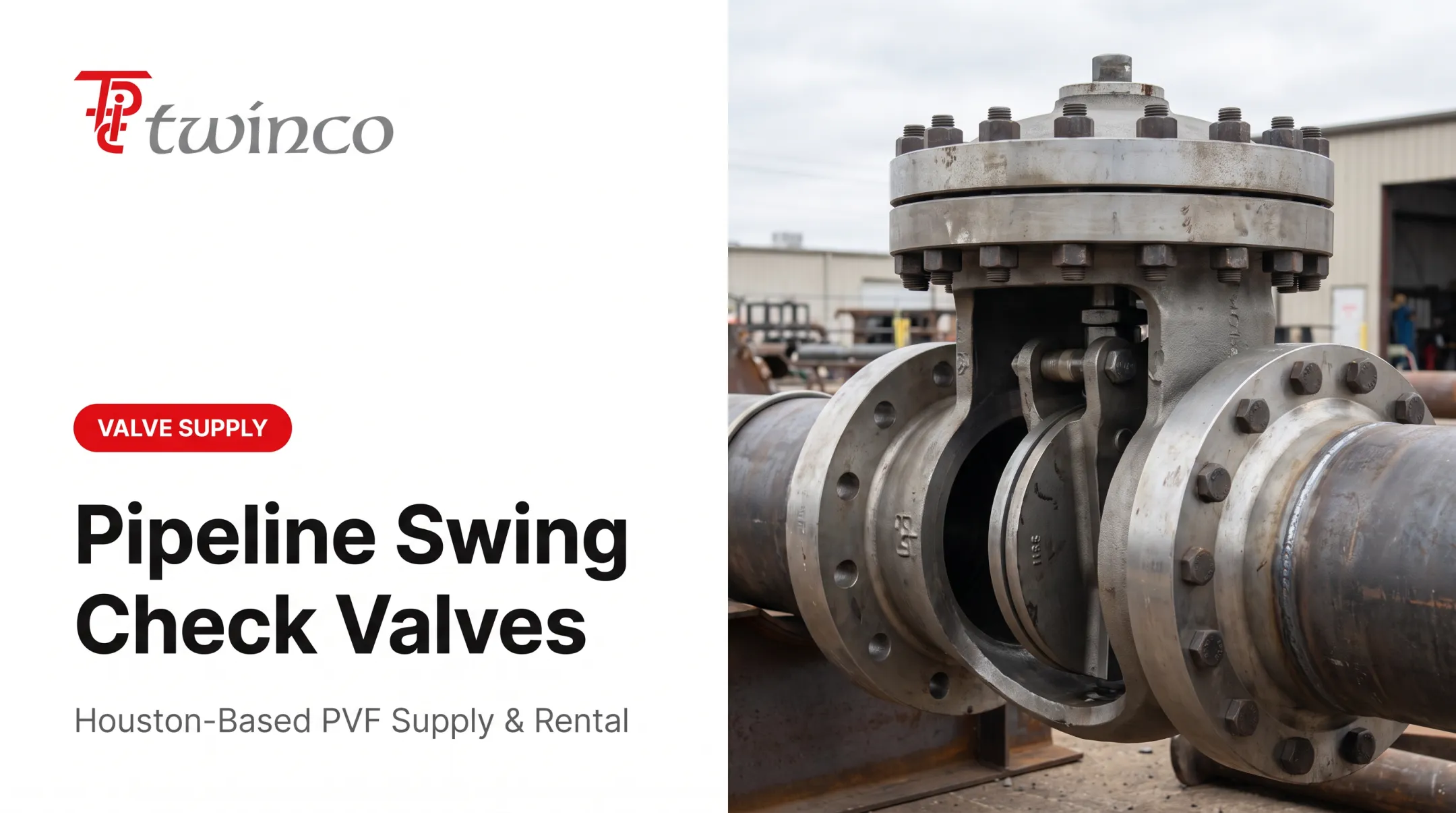
Swing check valves rely on a hinged disc and gravity. They work well on steady flow but can slam shut hard under sudden reversal, which is exactly the condition compressor discharge lines create.
Lift and piston checks use a guided closure element instead. That design handles rapid reversal and pulsating flow more predictably.
Spring-loaded poppet and ball checks are compact and common in smaller-bore instrument or process-gas circuits. Many come with selectable cracking pressures to match a specific application.
Axial or nozzle checks use a spring-held disc in a streamlined flow path. They excel where fast closure and low pressure loss both matter. Diaphragm and other specialty checks serve clean, corrosive, or contamination-sensitive gas service, with sealing details that vary by manufacturer.
Twinco Industrial stocks swing, lift, and wafer check valve configurations, along with cast steel check valves in sizes 2 inches to 48 inches (Classes 150 to 2500) and forged steel check valves from 1/4 inch to 2 inches (Classes 150 to 4500) for higher-pressure, higher-temperature service. Materials span carbon steel, stainless steel, brass, and high-alloy options.
The takeaway: match the design to line size, flow rate, pressure range, orientation, and cycling frequency, then ask the manufacturer for verified flow, leakage, and material data for the actual gas service. The valve's name tells you less than its data sheet does.
How to Select a Check Valve for Gas Service
Start with a specification checklist, not a size number. Before contacting a supplier, confirm:
- Gas composition and any contaminants present
- Pressure range (normal and maximum) and temperature range
- Normal and maximum flow rate, plus line size
- Operating orientation and required flow direction
- Whether the gas is flammable, toxic, corrosive, sour, or oxygen-enriched
Evaluating Pressure Performance
Pressure data matters more than nominal pipe size:
- Confirm maximum allowable working pressure and temperature from the manufacturer's documentation, not a generic catalog range.
- Determine the required cracking pressure and verify normal system pressure can open the valve without restricting flow.
- Assess pressure drop at minimum, normal, and maximum flow—drop behaves differently across that range.
- Ask about transient conditions. Compressor pulsation or rapid shutdown can cause chatter, slam, or premature wear a static spec sheet won't show.

Materials, Connections, and Documentation
Material compatibility covers metal selection, elastomer compatibility, corrosion resistance, and particulate exposure. Sour gas service adds sulfide stress cracking resistance requirements on top of that.
End connections need equal attention. Flanged, threaded, socket-weld, or butt-weld options each carry different face-to-face dimensions, pressure class requirements, and gasket needs that must align with existing piping.
For any project of consequence, request:
- Dimensional drawings and material certifications
- Pressure and leakage test records
- Installation instructions and traceability documents
- Confirmation of applicable industry or site standards
Don't order by size alone. A complete spec upfront saves a return shipment later. Twinco Industrial's valve specialists, including valve expert Shane Holmes, work through the full specification with buyers before recommending a valve—and the related pipe, valves, fittings, gaskets, flanges, and bolting a project typically needs.
Applications, Installation, and Safety Considerations
Gas check valves belong anywhere backflow could damage equipment or create a safety hazard. Common industrial placements include:
- Compressor discharge and suction piping
- Transmission and distribution lines
- Fuel-gas trains and gas processing equipment
- Storage and loading systems
- Burner connections and instrument-gas circuits
Installation Basics
Getting installation right prevents most early failures:
- Verify the flow arrow before installation, every time
- Install in the manufacturer-approved orientation, not whatever's convenient
- Keep the line clean of debris and construction residue
- Support adjacent piping independently; never let the valve carry pipe weight
- Confirm gaskets and connection hardware match the pressure class
Commissioning and Safety
Before startup, inspect for shipping damage and contamination, then pressure-test according to the approved procedure and check for leakage.
OSHA's lockout/tagout standard requires isolation, blocking of stored energy, and verification before anyone services connected equipment. A check valve is not an energy-isolating device on its own.
Hazardous-gas work still calls for qualified personnel following a documented depressurization procedure. Twinco supports this stage with rental chart recorders for pressure and temperature documentation during commissioning and hydrostatic testing.
Troubleshooting, Inspection, and Replacement
A check valve rarely fails without warning signs. Catching them early prevents a bigger shutdown later.
Symptoms Worth Investigating
- Reverse flow or unstable downstream pressure
- Unexpected gas migration after shutdown
- Noise, vibration, or chatter during operation
- Visible leakage at the seat or body
- Failure to open at the expected pressure
Common Causes
These symptoms usually trace back to common root issues:
- Incorrect installation direction
- Debris sitting on the seat
- Damaged sealing surfaces
- Worn springs or hinges
- Incorrectly sized cracking pressure
- Corrosion from service conditions
- Excessive velocity or pulsation beyond the valve's rating
No single cause fits every case, so a proper inspection matters more than a guess.
Inspection Process
- Isolate and depressurize the system under approved lockout procedures.
- Verify the valve and line are safe to open before disassembly.
- Inspect internal components and seals for wear, corrosion, or damage.
- Compare findings against the manufacturer's stated service limits.

Replacement and Documentation
Replacement usually beats repair when pressure-containing parts, seats, seals, or required test records can't be verified. Trying to reface a damaged seat without documented traceability introduces more risk than it removes.
Document the valve tag, service conditions, failure symptoms, inspection findings, and test results every time. That record prevents the same failure from repeating during the next maintenance cycle or turnaround.
Frequently Asked Questions
Is a fuel check valve necessary?
A fuel-system check valve may be needed to prevent reverse flow, protect connected equipment, or maintain proper system function. The specific design must follow the equipment manufacturer's requirements and applicable safety standards.
What are the symptoms of a bad check valve?
Watch for reverse flow, pressure instability, leakage, unusual noise, chatter, excessive pressure drop, or failure to open at the expected pressure. Have a qualified technician inspect the valve before removing it from a gas system.
How much pressure does a check valve need?
Cracking pressure is the minimum differential needed to start opening the valve, which is different from its maximum allowable working pressure. Both values depend entirely on the specific valve design and application, so check the manufacturer's data sheet.
What is a gas check valve?
A gas check valve is an automatic one-way valve that lets gas move in the intended direction and closes to limit reverse flow. Selection depends on gas composition, pressure, temperature, flow rate, and connection requirements.