Picking the wrong one is expensive. A mismatched thread or an undersized fitting can mean leak paths, cross-threading, galling, or a fitting that cracks under pressure it was never rated for. Rework on a live jobsite costs more than the fitting ever did.
This guide walks through the main fitting types, the thread standards that govern them, sealing methods, and the checks you should run before an order ships. Whether you're specifying parts for a pipeline tie-in or restocking a maintenance shop, the goal is the same: get the right fitting the first time.
Key Takeaways
- Match the joint with the right form: elbows, tees, couplings, unions, nipples, plugs, and related fittings.
- NPT, NPTF, BSPP, and BSPT threads are not interchangeable, even when nominal sizes look identical.
- Select on geometry, thread, size, material, pressure, temperature, and medium together—not one factor alone.
- Accurate thread measurement and documentation prevent leaks, damage, and rework.
- Confirm thread form and compatibility with a PVF supplier before you place the order.
What Are Threaded Pipe Fittings and Why Are They Important?
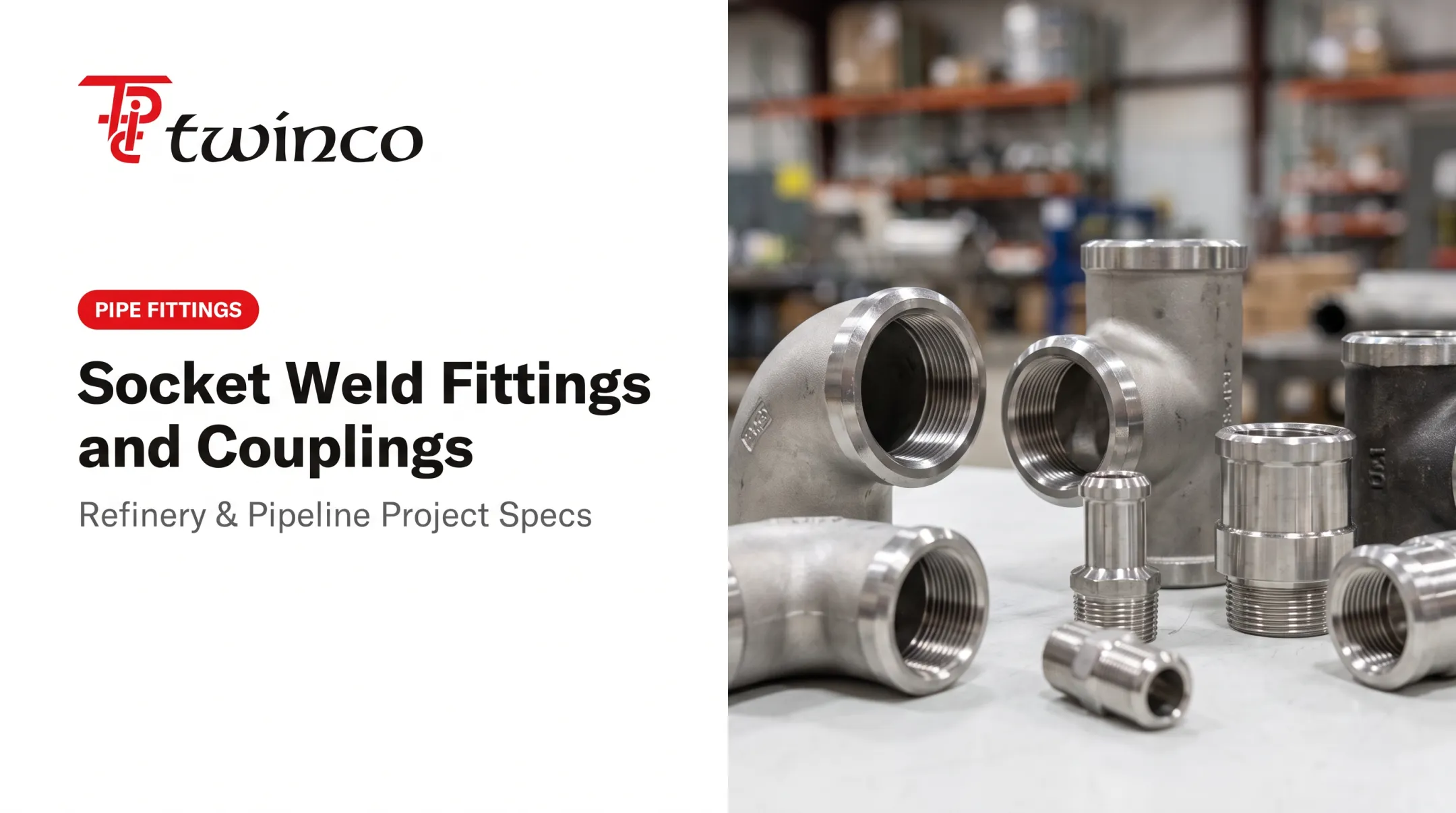
A threaded pipe fitting is a component with internal threads, external threads, or both, built to join threaded pipe or other threaded parts without welding. That's the core distinction from socket-weld or flanged connections: threaded joints go together and come apart mechanically.
Threads come in two genders:
- Male threads — external, cut on the outside of the fitting or pipe end
- Female threads — internal, cut inside the fitting's bore
Some fittings carry the same thread standard on both ends. Others combine male and female, or even two different thread systems, depending on the transition needed.
Where These Fittings Show Up
Industrial applications for threaded fittings include:
- Process piping and utility systems
- Equipment and instrument connections
- Maintenance work and pressure testing
- Temporary isolation and permanent installations
Twinco Industrial, for instance, stocks small bore threaded fittings such as elbows, tees, couplings, unions, reducers, bushings, and olets. These support process piping, instrumentation, and skid assemblies in high-pressure service.
Two Attributes, Not One
Fittings get selected by two separate factors that people often collapse into one:
- Physical configuration — what the fitting does (elbow, tee, coupling)
- Thread specification — how it connects (NPT, BSPT, and so on)
Getting the shape right but the thread wrong is just as much a failure as the reverse. Correct selection on both fronts controls leak resistance, flow direction, and pressure containment. It also cuts the downtime crews spend chasing a bad joint.

What goes wrong with mismatched fittings:
- Cross-threading during assembly
- Spiral leak paths along mismatched thread forms
- Galling on stainless-to-stainless connections
- Cracking from overtightening or incompatible materials
- Inadequate thread engagement leading to premature failure
Governing standards vary by fitting type and material:
- Forged threaded fittings generally follow ASME B1.20.1 for thread dimensions, alongside ASME B16.11
- Malleable-iron fittings follow ASME B16.3
- Corrosion-resistant fittings follow MSS SP-114
No single standard covers every service, so match the standard to the fitting and material in front of you.
Types of Threaded Pipe Fittings
Fitting types differ by several factors:
- Function (redirect, branch, or join)
- Number of connection points
- Connection ends
- Thread standard or pressure class
The same basic shape—an elbow, for example—can show up in many materials, sizes, pressure classes, and thread combinations.
Elbows
Elbows change the direction of a piping run, most commonly at 90 degrees or 45 degrees. Confirm which angles and configurations are actually stocked for your application before designing around one.
Common uses include:
- Compact equipment skids and tight layouts
- Utility piping runs
- Routing around structural or mechanical obstacles
Every elbow adds a threaded joint and a pressure drop. More turns mean more routing flexibility, but also more potential leak points and more installation time. Twinco stocks long-radius and short-radius elbows in its standard fitting range. That choice affects both flow characteristics and installation clearance.
When selecting an elbow, verify:
- Material compatibility
- Pressure rating at operating temperature
- Thread engagement depth
- Orientation relative to adjacent equipment
Tees and Crosses
A tee creates one branch off a main run. A cross has four connection points instead of three, though crosses are less common in industrial systems because they concentrate stress at one junction.
Both come in two configurations:
- Equal — all openings share the same nominal size
- Reducing — at least one opening is smaller, affecting flow distribution and what can connect downstream
Twinco supplies equal tees, reducing tees, and crosses in threaded and cast lines. Typical uses include instrument branches, drains, vents, and process takeoffs. Always confirm threaded construction is permitted for that service before you specify one.
Branch fittings carry extra design load: flow balance, pipe support, vibration resistance, and pressure containment all matter more here than on a straight run. Maintenance access to the branch connection is worth checking too, since these are often the points technicians return to repeatedly.
Couplings, Unions, and Bushings
Couplings join two similarly sized threaded pipe sections. Reducing couplings or bushings connect different nominal sizes. Unions exist specifically to make disconnection easier during maintenance, without rotating the connected pipe runs.
| Fitting | Purpose | Best for |
|---|---|---|
| Full coupling | Joins two same-size pipe ends | Straight-run extensions |
| Half coupling | One threaded connection point | Branch or vessel nozzle attachment |
| Reducing coupling | Joins two different sizes | Size transitions on a straight run |
| Union | Demountable joint | Frequent disassembly, maintenance access |
A bushing typically has external threads on one end and internal threads on the other, adapting between sizes. It's a compact solution, but it can reduce internal flow area more than a proper reducing fitting would.
Avoid stacking multiple bushings or reducers to bridge a size gap. Every added joint is another leak path and another spot that complicates inspection later. One correctly sized reducing fitting almost always beats two or three adapters chained together.
Adapters, Nipples, Plugs, and Caps
These four are easy to mix up, so definitions matter:
- Nipples — short pipe sections with external threads on both ends. ASTM A733 covers welded and seamless carbon-steel and austenitic-stainless nipples in standard and special lengths.
- Adapters — transition between thread sizes or connection types (threaded-to-weld, threaded-to-flange)
- Plugs — closures with threads, internal or external, that seal an opening
- Caps — closures that fit over an external pipe end
Common configurations include male-to-male, male-to-female, female-to-female, and reducing versions of each. Threaded-to-weld or threaded-to-flange transitions belong only where that specific transition is actually required. Don't treat an adapter as a general substitute for a standard fitting.
These parts show up in equipment connections, temporary isolation, line termination, pressure testing, and fabrication work that ties pipe to valves.
One distinction matters more than it seems: a pressure-rated closure built to hold system pressure is not the same as a protective cap meant to keep debris out during shipping. Confirm which one you're actually buying.
Thread Types and Sealing Methods
Thread standards are where most compatibility mistakes happen, mainly because two different systems can look nearly identical at a glance.
Tapered threads (NPT, NPTF, BSPT):
- Rely on thread interference for sealing
- NPT is the standard US tapered pipe thread, governed by ASME B1.20.1
- NPTF uses a modified "dryseal" geometry under ASME B1.20.3
- Crushed crests and roots can form a pressure-tight joint under the right tolerances, though field conditions usually still call for sealant
Parallel threads (NPSM, BSPP):
- Rely on a gasket, washer, O-ring, or sealing face, not the thread itself
- ISO 228-1 specifies that BSPP threads are not intended to form a pressure-tight joint on the thread alone
Never force NPT and BSP threads together, even when nominal sizes or thread counts look close. They come from different origin standards with different taper angles and pitch. Use a properly specified transition adapter instead.

For sealant selection, check:
- Fitting and pipe material
- Service medium and chemical compatibility
- Operating pressure and temperature
- Manufacturer-specific instructions for that sealant
One rule that gets ignored too often: sealant cannot fix a bad thread. It will not correct damage, wrong sizing, incompatible standards, or insufficient engagement.
Overtightening a fitting to "make it seal" usually cracks the fitting or damages the equipment it attaches to. It does not fix the underlying problem.
How to Choose the Right Type of Threaded Pipe Fitting
The right fitting is determined by the complete application, not by nominal size or shape alone. Run through these checks in order.
Purpose and Configuration
Start by locking the job and the geometry:
- Decide the function: redirect flow, create a branch, join pipe, reduce size, connect equipment, or close a line
- Confirm connection points, angle, equal versus reducing configuration, and male/female ends
- Check installation clearance before committing to a shape
Thread Standard, Size, and Engagement
Confirm the thread designation, nominal pipe size, pitch, and whether it's tapered or parallel. Then verify the mating component uses the same standard.
If the thread is unknown, work through it methodically:
- Check any component documentation or markings first
- Measure the male outside diameter or female inside diameter
- Check pitch with a thread gauge
- Determine whether the thread is tapered or parallel

Don't rely on visual similarity or nominal inch labels alone. NPT and BSP threads can look close enough to force together, which is exactly how cross-threaded joints happen on the jobsite.
Material and Service Compatibility
Match the fitting material to the pipe, conveyed fluid, temperature range, and corrosion environment. Common industrial choices—carbon steel, stainless steel, malleable iron, brass, and engineered plastics—carry different service limits, so confirm compatibility before you order.
For regulated or documented projects, verify:
- Material certificates and traceability
- Coating requirements
- Customer or project-specific specifications
Pressure, Temperature, and Standards
Confirm the fitting's pressure class at your actual operating temperature, since ratings shift with material, size, and service conditions. Then verify the applicable dimensional, manufacturing, and testing standards, plus any project or regulatory requirements that apply.
A fitting that fits mechanically can still be the wrong choice for high-pressure, high-temperature, corrosive, or cyclic service. Mechanical fit and service suitability are two different questions.
Supplier, Availability, and Project Timing
Lead time and documentation matter as much as the part itself. Consider quantity needs, replacement availability, packaging, and what an emergency sourcing scramble actually costs a project on a fixed schedule.
Twinco Industrial supplies PVF components with specialty sourcing and responsive fulfillment for pipeline, petrochemical, construction, testing, and maintenance work. Rush procurement is available when a job can't wait.
When requesting a quote, give the supplier:
- Thread designation, size, and material
- Pressure and temperature requirements
- Service medium and quantity
- Delivery location and required documentation
What to Check Before Finalizing a Type of Threaded Pipe Fitting
A few final checks catch most of the mistakes that slip through earlier steps.
Before you finalize a fitting:
- Verify the complete thread designation, pitch, taper, gender, material, pressure rating, and mating component—not nominal size alone.
- Use a properly specified transition fitting when NPT, BSP, metric, or other standards differ; never force incompatible threads together.
- Inspect for damaged or crossed threads first. More sealant or torque will not fix a poor connection.
- Factor in vibration, thermal cycling, corrosion, and whether the joint will need future disassembly.
- Confirm the rating before using a general-purpose fitting in industrial process, pressure testing, or hazardous service.
Follow the fitting manufacturer's or governing standard's guidance on thread engagement, sealant application, inspection, and leak testing. Do not guess at torque values that were never specified for your exact material and size combination.
Conclusion
Threaded pipe fittings give piping systems a practical, weld-free way to join, redirect, branch, reduce, adapt, and terminate runs across industrial and construction environments. Getting the selection right means evaluating fitting geometry, thread standard, size, material, pressure, temperature, and sealing method together, not one at a time.
A reliable supplier makes that evaluation easier. Twinco Industrial has supplied pipe, valves, fittings, flanges, gaskets, and bolting for petrochemical, pipeline, and construction projects since 1977. For time-sensitive sourcing or hard-to-find components, call (713) 733-8946. Weekend calls go to (832) 754-6831, or email info@twincoindustrial.com.
Frequently Asked Questions
What do plumbers use on pipe threads?
Most use PTFE tape or a liquid thread sealant, chosen based on thread type, material, pressure, temperature, and the conveyed medium. There's no single sealant that works correctly across every application.
How do I tell what size pipe thread I have?
Check any existing documentation first. If that's unavailable, measure the male outside diameter or female inside diameter, check pitch with a thread gauge, and confirm whether the thread is tapered or parallel.
Is there a difference between NPT and pipe thread?
Yes. NPT is one specific US tapered pipe-thread standard. "Pipe thread" is a broader term covering multiple standards and forms, including NPT, NPTF, BSPP, and BSPT.
What are the different types of pipe thread fittings?
Common configurations include elbows, tees, couplings, unions, bushings, adapters, nipples, plugs, and caps. Fitting shape (the configuration) and thread standard (like NPT or BSPT) are separate specifications.
Where can I buy stainless pipe fittings?
Provide your supplier with size, thread standard, grade, pressure rating, quantity, and any required documentation. Twinco Industrial sources stainless PVF components for industrial customers, including hard-to-find sizes and grades.
What is a ferrule fitting?
A ferrule fitting uses a compression ring squeezed between a nut and fitting body to grip and seal tubing. It's a tube-fitting category, distinct from a conventional threaded pipe fitting that seals through thread engagement.