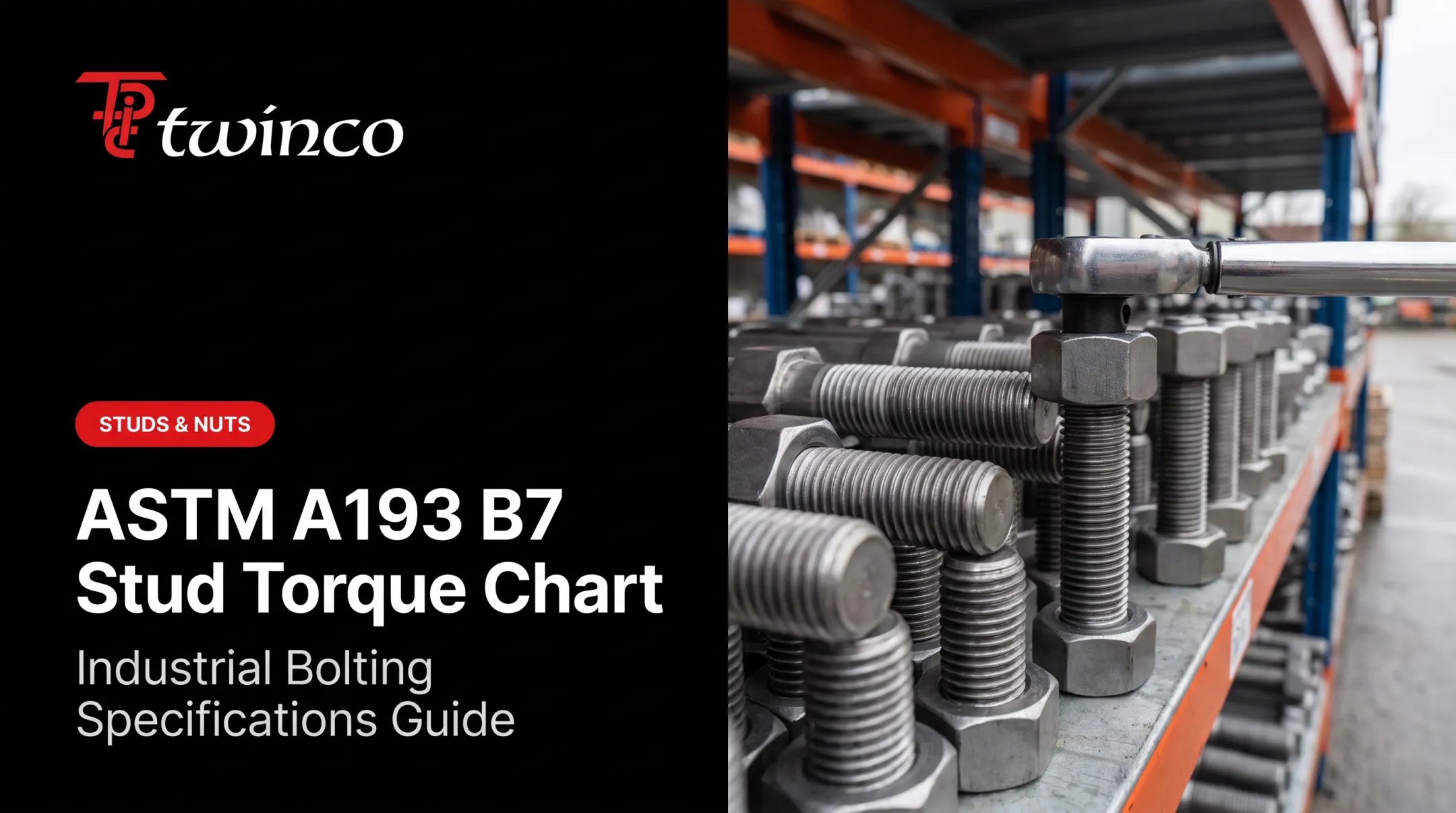
ASME B16.5 alone covers flange sizes from NPS 1/2 through 24 across seven pressure classes, and ASME's flange standard treats bolting dimensions as configuration-specific, not universal. Get the fastener wrong, and you risk leak paths, failed hydrotests, or a shutdown that runs longer than planned.
This guide walks through the terminology, how studs and bolts actually function inside a flanged joint, a practical selection process, and what to check during installation and inspection.
Key Takeaways
- Flange studs and bolts work with nuts to clamp mating flanges and keep the gasket compressed under pressure.
- Fastener specification depends on flange size, pressure class, facing type, gasket thickness, and material grade together, not any single factor.
- Length matters: too short risks poor nut engagement, too long invites corrosion and clearance problems.
- Always confirm the governing standard, material certificates, and tightening procedure before ordering or installing bolting.
- Nonstandard, high-pressure, or high-temperature applications call for qualified engineering and inspection sign-off.
What Are Flange Studs and Bolts?
A flange stud (or stud bolt) is a threaded fastener used with a nut on each end to clamp two flanges together. Under ASME B18.31.2, some stud bolts are threaded along their full length, while others carry threading only at each end, with a smooth, unthreaded shank in between. The correct configuration depends on the flange standard and grip length required.
Stud Bolts vs. Machine Bolts
A stud bolt assembly runs through aligned flange holes with a nut threaded on both ends. There's no head to worry about, which simplifies installation in tight quarters where swinging a wrench around a bolt head isn't practical.
A hex machine bolt, by contrast, has a head on one end and a nut on the other. That head needs clearance on one side of the joint, which can matter on congested piping or where access is limited from only one direction.
The Fastener's Job
The stud or bolt applies and holds clamping force so the gasket stays compressed. That clamping force is what lets the joint resist internal pressure, vibration, and thermal cycling without leaking.
Keep the fastener distinct from the rest of the joint:
- Hex nuts and flange nuts — threaded components that develop clamp load with the stud
- Washers — bearing surfaces that distribute load and protect flange faces
- Gaskets — the sealing element compressed between flange faces
- Flanges — the mating components being joined
Each has its own specification. Calling everything a "flange bolt" during purchasing invites confusion. The actual requirement should identify fastener type, dimensions, material grade, thread, coating, and governing standard.
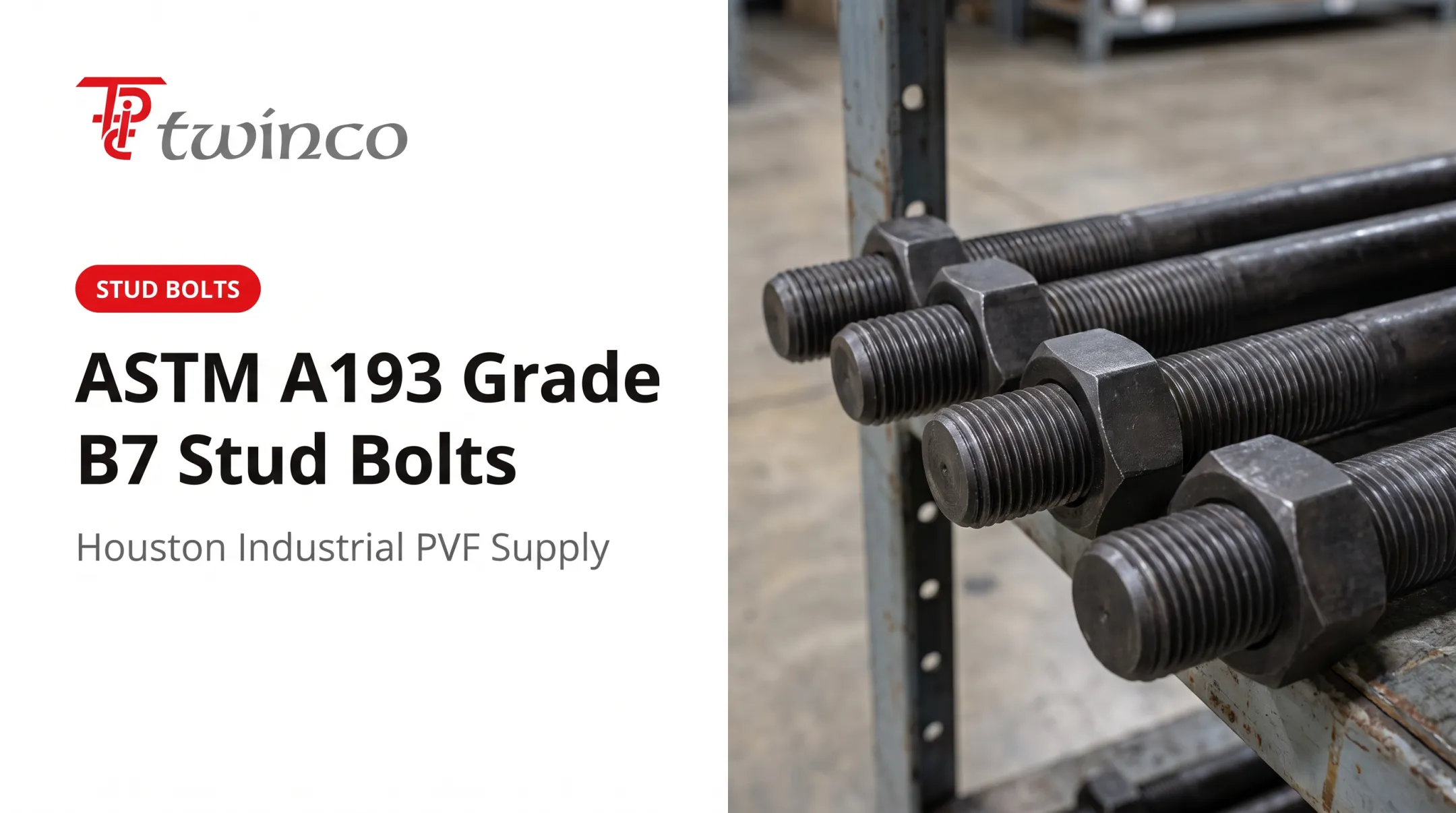
You'll see flange studs and bolts across pipeline construction, refinery and petrochemical piping, power plant maintenance, pressure testing, fabrication shops, and equipment tie-ins. Twinco Industrial supplies stud-and-nut packages for these jobs, most often ASTM A193 B7 studs paired with ASTM A194 2H heavy hex nuts for hydrotest work.
How Flange Studs and Bolts Work in a Flanged Joint
Clamping load travels from the nuts, through the stud or bolt, into the flange faces, and finally into the gasket. If that load isn't even across every fastener, some areas of the gasket compress more than others, which is exactly how leak paths start.

Flange Design Drives Bolting Requirements
Several variables shape what fastener a joint needs:
- Nominal pipe size and pressure class
- Flange thickness
- Bolt-hole pattern and hole count
- Facing type (raised face, ring-type joint, or flat face)
Raised-face (RF) joints seat a gasket directly against a machined face inside the bolt circle. Ring-type-joint (RTJ) flanges use a metallic ring gasket seated in a machined groove, sealing by line contact rather than surface compression.
These two arrangements don't share the same gasket geometry, so they don't always share the same fastener length or installation approach either.
Grip Length and Why It Matters
The effective grip length is the portion of the stud or bolt assembly carrying most of the joint load. Cut a stud too short, and you may not achieve full nut engagement, weakening the connection right when it needs to hold.
There's no single stud-length rule that works for every flange. ASME B16.5 and B16.47 provide bolt-length calculation figures specific to flange size, class, and facing. Check those tables, or the project specification, rather than reusing a length from a different job.
Length alone doesn't guarantee a reliable joint. Other factors that decide whether the joint holds under service conditions include:
- Material strength
- Gasket selection
- Flange condition
- Tightening sequence
- Lubrication
How to Choose the Correct Flange Studs and Bolts
Selecting bolting correctly means working through a sequence, not guessing at a diameter.Selecting bolting correctly means working through a sequence, not guessing at a diameter. Work flange identity, length, material, thread, and gasket type in that order before you place the order.
Step 1: Identify the Flange
Before ordering anything, confirm:
- Nominal size and pressure class
- Facing type (RF, RTJ, or flat face)
- Governing flange standard (ASME B16.5, B16.47, or project spec)
- Flange material
- Bolt-hole quantity and diameter
Step 2: Determine Required Length
Length calculations need to account for:
- Combined thickness of both mating flanges
- Gasket thickness
- Washers, if the spec calls for them
- Nut height
- Desired thread projection beyond the nut
Don't rely on a generic length chart alone. Verify against the applicable standard or manufacturer chart for your exact flange and facing combination.
Step 3: Select Material and Grade
Material selection depends on strength, temperature, corrosion exposure, and the process fluid involved. ASTM A193 covers alloy and stainless bolting for high-temperature and high-pressure service, including familiar grades like B7, B7M, B8, and B8M. ASTM A320 covers low-temperature applications, including L7 and B16.
Twinco stocks studs across these common grades:
| Grade | Typical Use |
|---|---|
| A193 B7 | General high-strength, elevated-temperature service |
| A193 B7M | Sour service where hardness limits apply |
| A193 B8/B8M | Corrosion-resistant stainless applications |
| A320 L7/B16 | Low-temperature, heat-treated service |
Match nuts to the stud grade—A194 2H with B7, 2HM with B7M, and stainless nuts with stainless studs—and confirm the pairing against the piping specification.
Step 4: Confirm Thread Compatibility
After grade is set, check nominal diameter, thread series (UNC, UNF, or metric), pitch, and thread condition. A stud and nut that don't share the same thread system won't engage properly, no matter how close the sizes look on paper.
Step 5: Account for Gasket Type
Gasket choice loops back to length and preload. Spiral wound, RTJ, and compressed fiber gaskets each compress differently, so thickness and behavior both matter. Don't swap gasket types or fastener specs without engineering approval—one change can throw off the whole assembly.

Purchasing Checklist
Before placing an order, confirm:
- Quantity, diameter, and length
- Grade and coating/finish (plain, zinc, Xylan, PTFE, hot-dip)
- Nut type and grade
- Thread specification
- Governing standard
- Certification requirements
- Delivery timeline
Twinco Industrial stocks new and rental bolting in carbon steel, alloy, stainless, and specialty materials, including cut-to-length, standard-stock, and pre-assembled stud-and-nut packages. Send the checklist details above with your quote request so the fastener recommendation matches the flange and service conditions.
How to Install and Inspect Flange Studs and Bolts
Getting the right fastener is half the job. Installing it correctly is the other half.
Before You Start
Run through these checks first:
- Confirm fastener size and grade match the specification
- Inspect threads and bearing surfaces for damage
- Verify flange alignment
- Clean flange faces
- Check gasket condition
- Confirm the system is depressurized and safe to work on
Placement and Tightening
Align flanges without forcing them together, then set the gasket squarely so it doesn't shift during bolt-up. Studs should pass through the holes without dragging on threads or nicking the gasket edge.
Tightening should follow a staged, cross-pattern sequence rather than a single pass around the bolt circle. This approach counters elastic interaction between fasteners, where tightening one stud slightly loosens its neighbors. Industry guidelines on bolted flange joint assembly recommend multiple tightening rounds to reach even gasket compression.
Reference your project's approved torque or tension procedure. Lubrication, tool calibration, and surface condition all change the relationship between applied torque and actual preload, so unsupported torque values aren't reliable across different jobs.
Twinco Industrial's rental hydraulic tools, including torque wrenches and stud tensioners, are serviced and calibrated before every rental, which helps keep that torque-to-preload relationship consistent in the field.
After Tightening
Check for:
- Visible thread projection beyond each nut
- Full nut seating
- Uniform flange gap around the circumference
- Gasket extrusion or visible damage
- Signs of misalignment
- Thread galling or cross-threading
Retightening, hot torquing, and post-installation inspection are procedure-dependent activities. They require the applicable code, the owner's specification, and personnel qualified to perform them.
Safety note: Flange joints can retain hazardous pressure or stored energy even after a system appears shut down. Don't loosen, tighten, or inspect a joint until isolation and work-control requirements are fully satisfied.
Common Flange Stud and Bolt Problems to Avoid
Most bolting failures trace back to a handful of recurring mistakes.
Incorrect length tops the list:
- Studs cut too short may never achieve full nut engagement
- Studs left too long can interfere with adjacent equipment, expose more thread to corrosion, and complicate future maintenance
Mixing incompatible components creates failures that may not show up until the joint is loaded:
- Mismatched thread systems between stud and nut
- Incorrect nut grade for the stud material
- Unapproved washers
- Materials that don't match flange specification or service conditions
Installation errors compound quickly on a busy job site:
- Uneven or single-pass tightening
- Damaged threads from rough handling
- Dirty flange faces
- Reused or stretched hardware
- Misaligned flanges forced together
Even a clean install is not the end of the risk. Corrosion, galling, heat exposure, vibration, and repeated maintenance cycles all degrade bolting over time. Galled fasteners should be replaced, not reused, since seized threads rarely torque down predictably a second time.

Document the installed fastener specification, tightening method, and inspection findings after every job. That record saves time at the next shutdown when crews need to confirm what is holding the flange together.
Frequently Asked Questions
What is a flange stud?
A flange stud, or stud bolt, is a threaded fastener used with nuts on both ends to clamp two flanges together. Exact dimensions and material depend on the flange size, pressure class, and applicable service specification.
What are the stud sizes for flanges?
Stud diameter, length, quantity, and thread are determined by flange size, pressure class, bolt-hole pattern, facing type, gasket, and the governing standard. Always check the relevant flange chart or project specification rather than assuming one size fits similar-looking flanges.
What is the difference between a nut and a flange nut?
A standard nut is a separate hexagonal threaded component. A flange nut includes an integral flange under the nut body that can distribute load and serve as a bearing surface. Substituting one for the other requires specification approval.
What is flange mounting?
Flange mounting means joining equipment or piping components through mating flanges, a gasket, and fasteners. Proper alignment, even gasket compression, and controlled tightening all matter for a reliable connection.