Introduction
Every pump shutdown creates a moment of risk. Without something to block reverse flow, backflow can slam through piping, damage pump seals, and destabilize an entire process line.
Check valves solve this by opening for forward flow and closing automatically once flow tries to reverse. As Val-Matic notes, a properly selected check valve on a pump discharge line minimizes energy consumption and protects piping from pressure surges when the pump isn't running.
Lift check valves and swing check valves are the two most common designs used to do this job. Both prevent reverse flow, but they get there through different disc movements and flow paths.
That difference affects pressure drop, valve slam risk, sealing performance, installation orientation, and how much maintenance you'll be doing down the road.
Choosing the wrong one can mean chronic fouling, water hammer, or a valve that simply doesn't close fast enough. This guide breaks down how each design works and where each one fits.
Key Takeaways
- Both types allow forward flow and close on reverse; lift discs travel straight, swing discs pivot.
- Lift checks seal tighter and faster; swing checks give a straighter path and lower resistance.
- Medium, flow profile, piping layout, and pressure or temperature needs decide which design fits.
- Confirm size, pressure class, materials, end connections, flow direction, and cracking pressure before ordering.
Lift Check Valves vs. Swing Check Valves: Quick Comparison
The fastest way to understand these valves is side by side. Here's how they stack up across the factors that actually matter in the field.
| Factor | Lift Check Valve | Swing Check Valve |
|---|---|---|
| Disc movement | Disc or piston moves linearly, straight up off the seat | Disc pivots on a hinge pin, typically 60–90 degrees |
| Flow path | Fluid changes direction around the closure member | Relatively straight-through path when open |
| Closure speed | Often fast, especially spring-assisted or silent-check designs | Longer travel means more inertia before the disc reseats |
| Water hammer risk | Lower in spring-assisted models | Higher in conventional designs with no spring assist |
| Installation | Often horizontal only, cover facing up (design-dependent) | Horizontal or vertical with upward flow, depending on model |
| Fouling sensitivity | Narrower internal passages, more sensitive to debris | Larger passage, but hinge pins and pockets still trap sediment |
Pressure drop doesn't follow a simple rule. Val-Matic design data for a 12-inch valve lists a silent check (lift-style) at a Cv of 2,480 and a swing check at 3,395. A nozzle-style lift check in the same size jumps to 4,700 — higher than the swing check.
Internal geometry, not the lift-versus-swing label, drives pressure loss. Always pull the manufacturer's Cv or head-loss curve for your specific model and size before assuming one design wins on flow resistance.

What Is a Lift Check Valve?
A lift check valve is a non-return valve where fluid pressure lifts a guided disc or piston off its seat to allow forward flow. When flow reverses, gravity, back-pressure, or a spring pushes the closure member back down onto the seat.
Unlike a straight-through body, fluid inside a lift check typically changes direction around or beneath the disc. That geometry is part of why pressure drop and debris accumulation can run higher than in some other check-valve designs.
Lift check is a category of related designs:
- Conventional gravity-operated lift checks
- Spring-assisted lift checks
- Piston check valves
- Nozzle check valves (smoother, venturi-shaped path)
- Silent check valves (short travel, fast reseating)
Advantages and Limitations
Spring-assisted and silent check designs can close in roughly one-tenth of a second, thanks to short linear travel and low disc inertia. That speed helps limit the reverse velocity that causes slam.
The trade-off: narrower passages and internal guides make lift checks more sensitive to fouling. Solids, debris, or high-viscosity fluids can bind the disc or prevent full closure. Spring force also adds resistance to opening, so you'll need to verify the minimum flow or cracking pressure required. Otherwise the valve may chatter or stay partially open.

Use Cases of Lift Check Valves
Lift checks tend to show up where tight sealing and rapid closure matter more than absolute minimum pressure loss:
- High-head pump discharge lines
- Clean process fluid service
- Compact, high-pressure industrial and power-plant piping
Procurement checklist for lift check valves:
- Installation orientation (horizontal vs. vertical, per manufacturer)
- Nominal size and pressure class
- Body, trim, and seat materials
- Spring or piston configuration
- End connection type and flow direction
- Required testing and documentation (API 594, ASME B16.34)
Twinco Industrial stocks cast steel check valves in sizes 2″ through 48″, Classes 150–2500, and forged steel check valves from 1/4″ to 2″, Classes 150–4500, depending on the specific design.
What Is a Swing Check Valve?
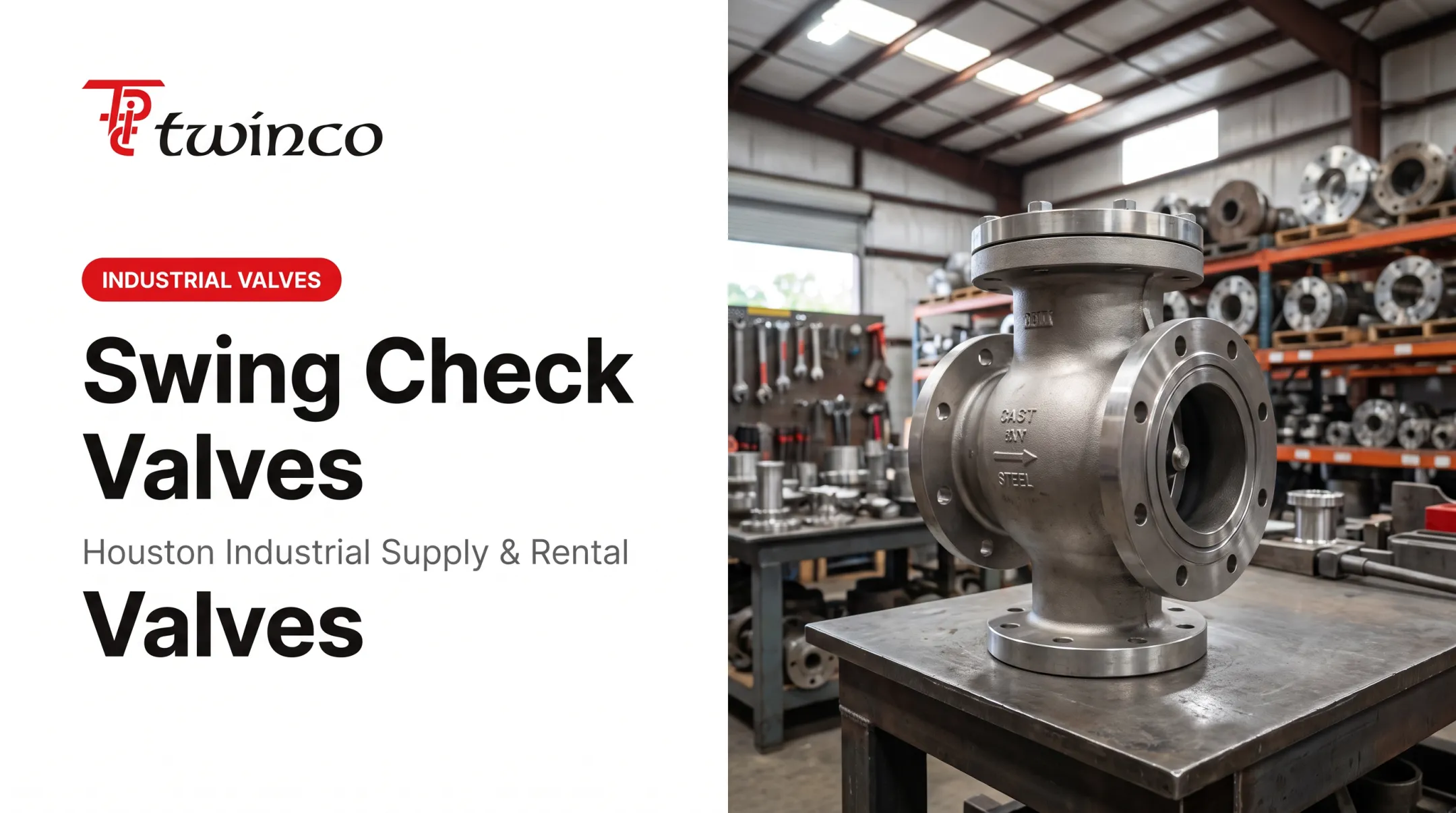
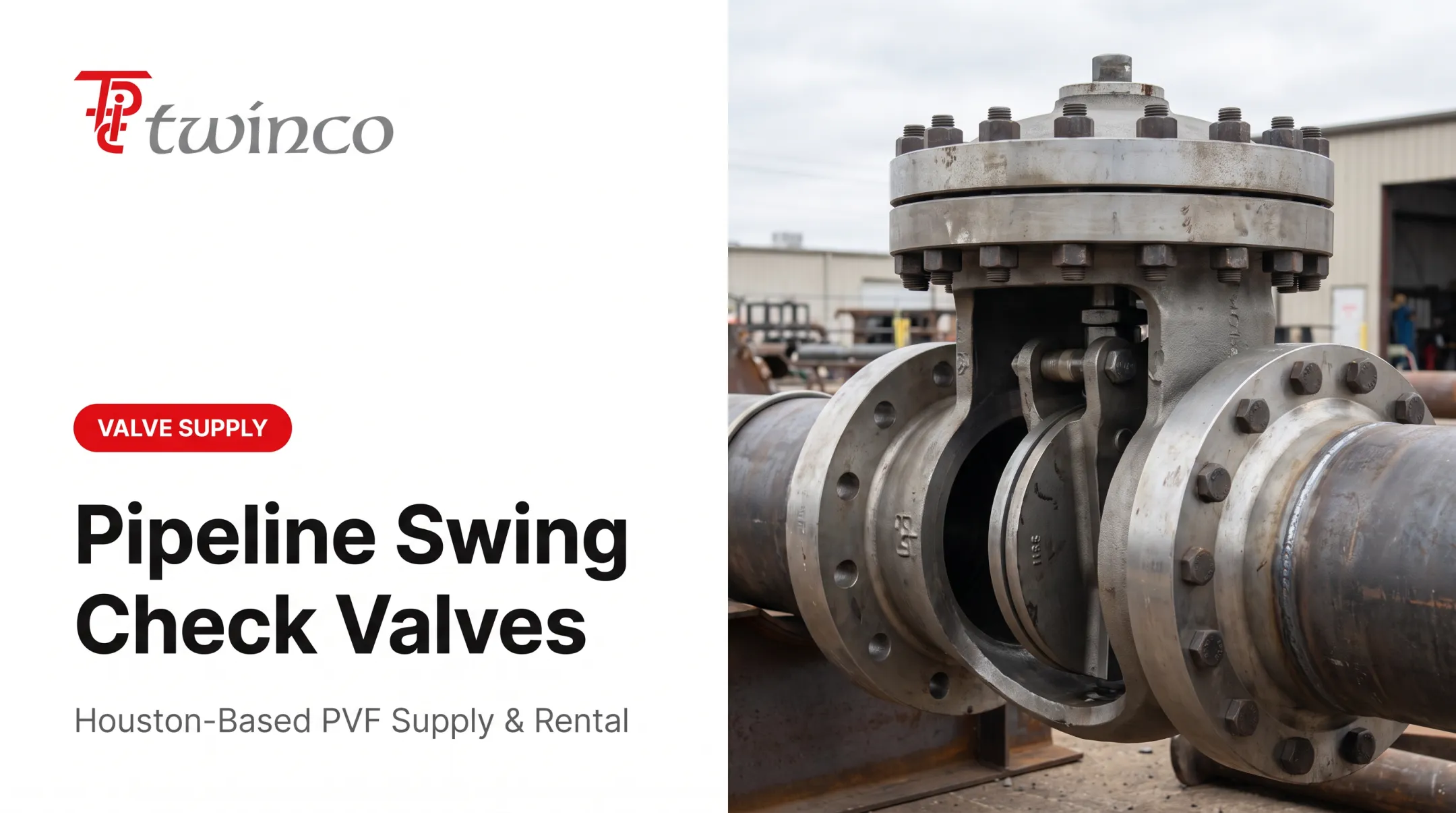
A swing check valve uses a disc mounted on a hinge or pin. Forward flow swings the disc open; reverse flow and gravity swing it back onto the seat. It's one of the oldest and most common non-return valve designs in industrial piping.
Because the disc swings clear of the flow path rather than blocking it from the side, swing checks have historically been common in water and wastewater pumping systems where a relatively open passage matters.
Closure Behavior and Slam Risk
The longer travel that gives swing checks their open flow path is also their biggest weakness. Traditional swing checks have no spring assist and a 60–90 degree stroke, which creates more disc inertia than a short-travel lift design.
Field testing backs this up: reverse velocity in one tested swing check condition exceeded 2.0 ft/s and was classified as severe slam. Pulsating flow, frequent pump cycling, and quick shutdowns all raise that risk.

Installation matters too. KITZ permits its swing-type check valves in horizontal or vertical piping, but requires upward flow when installed vertically — reversed orientation can prevent reliable closure entirely.
Use Cases of Swing Check Valves
Swing checks suit applications with:
- Stable, predominantly one-directional flow
- Water, wastewater, pipeline, and general process service
- Priority on low resistance over ultra-fast closure
They're a poor fit for severe pulsation, frequent cycling, strict non-slam limits, or services where solids can pack the hinge and seat.
Procurement and inspection checklist:
- Disc and hinge construction, seat type
- Body material and pressure/temperature rating
- Face-to-face dimensions (per ASME B16.10)
- Installation orientation and hinge-pin position
- Maintenance access for hinge, pin, and seat inspection
When those criteria point to a swing or piston check, Twinco Industrial stocks pipeline valves from 2″ to 60″ in Classes 150–2500 for oil and gas transmission, petrochemical, and energy infrastructure service.
Lift Check Valve vs. Swing Check Valve: Which Is Better?
Neither valve type wins outright. The right choice depends on the complete piping-system duty, not the valve name on the datasheet. For safety-critical, high-pressure, or hazardous service, loop in a qualified engineer or valve specialist before finalizing a spec.
Weigh these four factors:
- Medium: cleanliness, viscosity, solids content, and compatibility with body, trim, and seat materials.
- Flow and pressure: normal and maximum flow rate, line velocity, pump head, pressure class, and minimum pressure needed to crack the valve open.
- Closure behavior: allowable reverse flow, water hammer risk, pump shutdown profile, and cycling frequency.
- Installation and maintenance: available orientation, straight-pipe requirements, and access for inspection.
Situational guidance:
- Choose a lift-style design when tight closure, controlled seating, or a compact high-pressure layout matters more than the lowest possible pressure loss, and the medium will not foul internal passages.
- Choose a swing check when you need a relatively open flow path, stable one-directional flow, and a shutdown profile that will not trigger slam.
Verify any final selection against the manufacturer's datasheet and applicable standards. API 594, API 6D, MSS SP-71, and ASME B16.10/B16.34 govern dimensions, ratings, and testing for these valve categories.
Real-World Examples
Lift check application: Nozzle-style lift checks, with a smooth venturi-shaped internal path, are documented as steel valves used in high-pressure industrial and power-plant applications. Pressure class and flow geometry drove that choice, not the "lift" label alone.
Swing check challenge: DFT documented a vertical water line with high sediment content where sediment packed between the disc and body, nearly jamming the swing valve shut in low-cycle service. Sediment-heavy, low-flow vertical lines need a design suited to that duty. In both cases, operating conditions decided the outcome more than the valve family name.
If you're unsure which configuration fits your line, Twinco Industrial's valve specialist, Shane Holmes, works with pipeline, petrochemical, and industrial customers to match valve selections to the application.
Share your size, pressure class, material, connection type, and delivery timeline. The team can help identify a suitable option and will confirm availability before treating any item as in stock.
Conclusion
Lift check valves and swing check valves both stop reverse flow, but they do it through different mechanisms. Disc movement, flow path, closure speed, installation orientation, and fouling sensitivity separate the two designs.
The right pick matches the valve to your application, not to either design’s general reputation. Base the choice on:
- Medium and flow profile
- Pressure and temperature range
- Allowable reverse flow
- Maintenance plan
Before you order, confirm the specification with the valve manufacturer, a qualified engineer, or an experienced industrial supplier. That step matters most on critical energy, pipeline, petrochemical, and power applications where a wrong call is expensive to fix later.
Frequently Asked Questions
What is a lift check valve?
A lift check valve is a non-return valve where forward-flow pressure lifts a guided disc or piston off its seat. When flow reverses, gravity or a spring pushes the disc back onto the seat to stop backflow.
What is the difference between a swing check valve and a lift check valve?
A swing check disc pivots on a hinge pin, typically through 60–90 degrees, while a lift check disc moves in a straight line off the seat. This changes both the internal flow path and how quickly each design closes.
What type of check valve is a lift check valve?
A lift check valve is an automatic, non-return valve that requires no external power to operate. Common variants include spring-assisted, piston, nozzle, and silent check designs.
What is the purpose of a check valve?
A check valve allows flow in one intended direction and automatically blocks or limits reverse flow. It does this without manual, pneumatic, or electrical actuation.
What is a valve lift?
Valve lift is the distance a disc or closure member travels away from its seat when open. Greater lift generally increases flow capacity but can also affect how quickly the valve closes when flow reverses.