Introduction
A gas pipeline runs safely because someone can stop the flow when it matters. Valves make that possible. They control flow direction, isolate damaged or aging sections, limit how much gas escapes during an incident, and give crews a safe starting point for maintenance work.
Operators and contractors often treat "gas pipeline valve" as one product. It isn't. The term covers ball, gate, plug, check, butterfly, control, and relief designs, each built for a different job, pressure range, and gas service. Choose the wrong type and it won't just underperform—it can fail exactly when isolation matters most.
This guide breaks down the common valve types used in gas transmission and distribution, how block and isolation valves function during maintenance and emergencies, how to select the right valve for your project, and what to check before you buy or install one.
Key Takeaways
- Select valves by gas service, pressure and temperature range, line size, actuation method, and shutoff performance.
- Ball, gate, plug, check, butterfly, control, and relief valves serve distinct functions and are not interchangeable.
- Build reliability with block valves, bypasses, actuators, and inspection—not the valve body alone.
- Verify federal codes, standards, and documentation before purchase or installation.
Common Types of Gas Pipeline Valves
Before comparing valve types, it helps to separate function from design. "Block valve" describes a job: isolating a section of pipeline. "Ball valve" describes how the internal mechanism closes. A single function, like isolation, can be performed by several different valve designs depending on the project's requirements.
Ball Valves
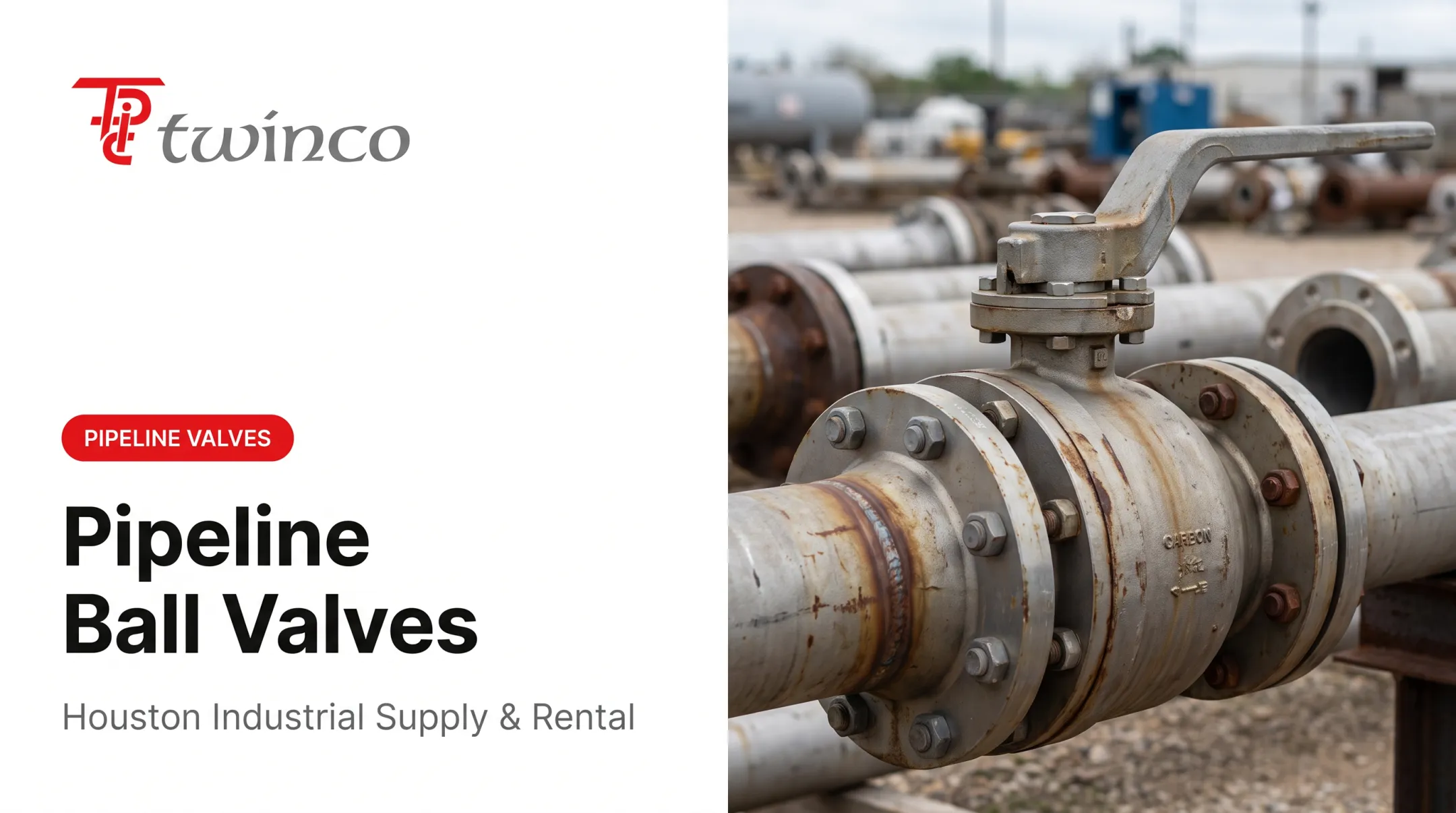
Ball valves use a rotating ball with a bore through the center. Turning the ball a quarter-turn opens or closes the flow path for quick, decisive shutoff.
- Full-bore (full-port) — bore matches the pipe ID so inspection gauges ("pigs") pass without obstruction
- Reduced-bore — smaller flow area; often acceptable when pigging is not required
- Floating ball — typically smaller sizes and lower pressure classes
- Trunnion-mounted — larger diameters and higher-pressure pipeline transport service
Twinco Industrial stocks floating ball valves in ½-inch to 24-inch sizes across Classes 150–1500, and trunnion ball valves in 2-inch to 60-inch sizes across Classes 150–2500, in carbon steel, stainless steel, and brass.
Choose floating or trunnion from the engineering requirements—size, pressure class, and service—not a general rule of thumb.
Gate Valves
Gate valves lift a flat gate out of the flow path, creating a straight-through, unobstructed passage with minimal pressure drop when fully open.
That straight-through path is why gate valves work well for on/off isolation, but poorly for throttling. Running a gate partially open can accelerate seat wear, cause vibration, or damage seating surfaces. Confirm intended service against the manufacturer's documentation before operating outside a fully open or fully closed position.
Cast steel gate valves are commonly available in 2-inch to 48-inch sizes, Classes 150–2500. Forged steel versions cover smaller sizes (¼-inch to 2-inch) at higher pressure classes up to 4500, suited to compact, high-pressure applications.
Plug Valves
Plug valves use a cylindrical or tapered plug rotating a quarter-turn to open or close the flow path. Lubricated plug valves are pressure-balanced designs often used in isolation duty, while taper plug versions are common in general gaseous service applications.
Before specifying a plug valve, check:
- Operating torque under the expected differential pressure
- Sealing design and lubrication requirements for the specific media
- Media compatibility with body and seal materials
These details vary by manufacturer, so confirm them against the selected valve's datasheet rather than assuming they carry over from a similar-looking product.
Check Valves
Check valves allow flow in one direction only, protecting compressors and interconnected equipment from reverse flow. Common configurations include swing, lift, wafer, cast steel, and piston designs—Twinco stocks these across a wide size range.
Closure behavior drives surge risk:
- Swing checks rely on gravity and flow; reversal can start before the disc seats and create surge on closure
- Spring-assisted, non-slam designs begin closing as forward velocity drops, limiting slam and reverse flow
Installation orientation and surge behavior differ by manufacturer, so compare datasheets before finalizing a selection.
Butterfly, Control, and Pressure-Protection Valves
Butterfly valves use a rotating disc for isolation or flow control in applications rated for the service. Control valves, by contrast, are built to modulate flow continuously and maintain a target pressure or flow condition rather than simply open or close.
In short, the roles split cleanly:
- Butterfly — isolation or control where the disc design is rated for the gas service
- Control — continuous modulation to hold a target pressure or flow
- Pressure protection (relief or limiting) — keeps the line from exceeding MAOP
Federal rule 49 CFR 192.195 requires pressure-protection devices wherever a gas-source connection could push a line over MAOP through a control failure.
Not every valve body style is rated for combustible gas service. Match selection to application-specific ratings and manufacturer data, not assumptions about what "should" work.
How Gas Pipeline Valves Work in Block, Isolation, and Emergency Applications
A block valve divides a pipeline into sections so a segment, station, or crossing can be isolated for maintenance, testing, inspection, or emergency response. "Block valve" and "isolation valve" often get used interchangeably in the field, but project specifications and operating procedures may define them differently. Always follow the terminology in your governing documents.
Mainline Block Valve Stations
A typical mainline block valve station pairs the main valve with a bypass valve, vent or blowdown equipment, instrumentation, and an actuator or control system.
Federal regulation 49 CFR 192.179 sets maximum point-to-valve spacing for transmission lines by population class:
- Class 4: 2.5 miles
- Class 3: 4 miles
- Class 2: 7.5 miles
- Class 1: 10 miles
Each section between mainline valves also needs a blowdown valve sized to depressurize the segment as quickly as practicable.
Pressure Equalization and Bypass Operation
Opening a large valve against significant differential pressure can damage seats or trigger flow conditions the valve wasn't built to handle. That's what bypass valves are for. A properly sized bypass equalizes pressure across the main valve before it opens, reducing stress on the sealing surfaces.
Operating sequences must always follow the approved procedure. Skipping steps to save time is one of the more common ways operators damage otherwise healthy valves.
Emergency Shutdown and Remote Operation
Pressure sensors, leak detection systems, and control centers can all trigger valve movement during an emergency. Terminology matters here:
- Remote-controlled valve (RCV) – operated from a control center via monitored communication
- Automatic shutdown valve (ASV) – closes automatically based on sensed conditions, without operator input
- Rupture mitigation valve (RMV) – either an RCV or ASV, defined under 49 CFR 192.3 specifically to minimize gas release and mitigate rupture consequences
PHMSA's Valve Rule, effective October 2022, requires RMVs (or approved equivalent technology) on qualifying new or replaced transmission segments 6 inches or larger in high-consequence areas or Class 3/4 locations. Under that rule, the valve must close as soon as practicable, and within 30 minutes of rupture identification, unless an approved safety rationale allows otherwise.

Valve Performance and Safety
A valve that leaks, fails to close, closes unintentionally, or responds too slowly can turn a routine maintenance window into a safety event. Consequences range from service interruption and equipment damage to gas release and risk to workers or the public.
Valve operation, isolation, depressurization, and re-pressurization should only be performed by qualified personnel following documented procedures. There's no shortcut here.
How to Select Gas Pipeline Valves for a Project
Selecting a gas pipeline valve takes several coordinated decisions. Work through the following steps in order.
1. Start with the gas and operating conditions. Document the service conditions first:
- Gas composition, including corrosive or sour constituents and moisture
- Temperature and pressure range, flow direction, and expected flow rate
- Whether the line must remain piggable
- Body, trim, seat, and seal material compatibility
- Fugitive-emission requirements for your service
2. Match the valve to its required function. Full isolation, throttling, non-return protection, emergency shutdown, pressure regulation, blowdown, or bypass duty each point toward different valve designs. Ask "what must the valve do?" before asking "which brand or model?"
3. Confirm size, pressure class, temperature, and end connections. Nominal pipe size and pressure class alone don't guarantee fit. Verify:
- Design and operating temperature range
- Face-to-face dimensions
- Flanged versus welded ends
- Compatibility with the pipeline specification and piping class
4. Evaluate manual versus actuated operation. Manual, pneumatic, hydraulic, electric, and gas-over-oil options differ in speed, available utilities, fail-safe position, and maintenance needs. Size the actuator from manufacturer data on breakaway torque, differential pressure, temperature, and seal friction—not from estimates.
5. Verify compliance and documentation. Confirm the applicable federal and industry requirements for your service before finalizing a purchase. Procurement teams typically need:
- Datasheets and material certifications
- Pressure-test records and inspection reports
- Traceability documentation
- Actuator manuals
6. Account for project and procurement constraints. Lead time, replacement interchangeability, and the availability of related flanges, gaskets, bolting, and fittings all affect whether a valve is usable on your timeline. A valve that fits dimensionally but arrives three weeks late, or without matching bolting, isn't a solution.

Deep, ready inventory is what makes that last step practical. Twinco Industrial stocks trunnion ball, thru-conduit gate, lubricated plug, swing check, and piston check valves in 2-inch to 60-inch sizes and Classes 150–2500, alongside the flanges, gaskets, and bolting needed to complete the connection.
Maintenance, Testing, and Sourcing Considerations
A valve's reliability depends as much on how it's maintained as how it's built. A basic inspection framework should cover:
- Visual condition, corrosion, and coating integrity
- Stem and actuator function
- Seal condition and bolting
- Position indication and operating torque
- Leakage, with findings documented in maintenance records
Under 49 CFR 192.745, each transmission-line valve that might be needed in an emergency must be inspected and partially operated at least once per calendar year, and no more than 15 months apart. An inoperable valve requires prompt corrective action unless an alternate valve has already been designated.
Watch for these warning signs, which typically call for qualified evaluation:
- Difficult or incomplete travel during operation
- External leakage at the stem, seals, or body
- Abnormal noise during actuation
- Damaged or unreliable position indicators
- Visible corrosion on the body or trim
- Repeated actuator faults or communication failures
Testing and commissioning requirements vary by valve type, pipeline specification, and applicable code. Confirm the procedure with your engineering team rather than assuming one project's requirements carry over to another.
Sourcing the right valve on a tight maintenance or turnaround schedule is a separate challenge. Twinco Industrial supplies industrial valves and related piping components, and can help evaluate availability or specialty-sourcing needs for pipeline maintenance, construction, testing, and emergency procurement.
Beyond valves, Twinco's rental and sales inventory covers the flanges, fittings, gaskets, bolting, pipe, and testing equipment that often need to be coordinated on the same job. Confirm the exact specification with your engineering documentation and request a project-specific quote before ordering.
Frequently Asked Questions
What is the purpose of a block valve in a gas pipeline?
A block valve isolates a defined pipeline section, so operators can handle maintenance, inspection, testing, or emergency response while limiting gas movement and potential release. It is a core structural safety feature in pipeline design.
What types of valves are used in gas pipelines?
Common designs include ball, gate, plug, check, butterfly, control, and pressure-protection valves. Suitability depends on the required function, service conditions, pressure ratings, and applicable codes, not the valve type alone.
What are the different types of block valves used in gas pipelines?
Block valves may use ball, gate, or plug designs. Selection depends on bore size, pressure class, sealing performance, pigging requirements, actuation method, and the project's governing specifications.
What is the difference between a block valve and an isolation valve in a gas pipeline?
Both terms generally describe stopping or separating flow, but exact meaning can vary by operator, specification, or code. Always follow the terminology defined in your project's operating procedures rather than assuming the terms are identical.