Introduction
Reverse flow in a pipeline is not a minor inconvenience. It can slam a pump, disrupt carefully controlled process conditions, introduce contamination between systems, or trigger a pressure transient that damages downstream equipment.
Swing check valves exist to stop that reverse flow automatically, without a handwheel, actuator, or operator standing by. This article covers how these valves are built, how they operate, how they compare with other check valve designs, and what to evaluate before you select or install one on a US pipeline or industrial system.
You'll also find the practical decision factors that matter most: fluid type, flow conditions, pressure and temperature, line configuration, applicable specifications, maintenance access, and delivery timelines. Get these wrong, and even a correctly manufactured valve can chatter, leak, or slam.
Key Takeaways
- Forward flow lifts the hinged disc open; reverse flow closes the valve automatically.
- Poor sizing or installation invites wear, leakage, or water hammer from low flow, turbulence, or slam shut.
- Choose by medium, pressure class, temperature, orientation, end connections, and project specs.
- Confirm final selection with a qualified engineer or valve specialist before purchase or install.
What Is a Pipeline Swing Check Valve, and How Does It Work?
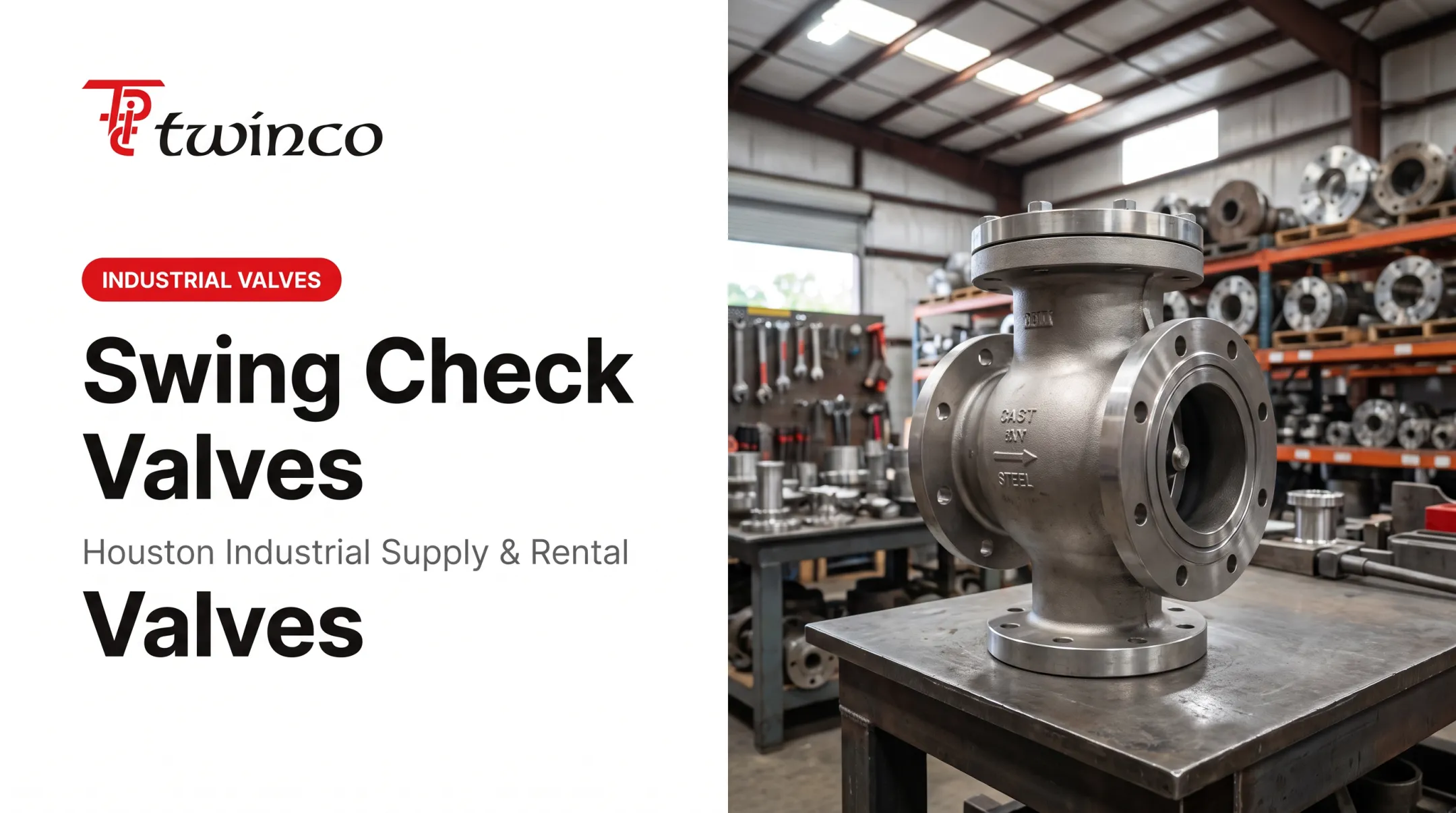
A swing check valve is a non-return valve that permits flow in one direction and restricts reverse flow using a hinged disc, not a powered mechanism. It requires no external actuation to function; the process fluid itself does the work.
Core Components and Terminology
The basic construction includes a valve body, a hinged disc or clapper, a hinge pin, a seat, and a bonnet or cover that provides access for inspection and repair. End connections vary by project (flanged, threaded, or welded), and exact internal geometry differs by manufacturer and service class.
On a project, these labels get used loosely. Keep them straight:
- Check valve – the functional family name for any self-actuated, one-way valve.
- Non-return valve – used interchangeably with "check valve" in most US industrial literature.
- Swing – identifies the closing mechanism (a hinged disc), not the broader function.
- Backflow valve – often a functional description rather than a specific construction; in potable-water code contexts it can refer to an entirely different assembly.
Swing check valves offer straightforward construction and low resistance to flow when fully open, which makes them attractive for larger pipeline sizes. The trade-off is that the disc needs adequate clearance to swing freely, and closure dynamics need attention during design.
The Opening and Closing Sequence
Forward flow generates enough pressure differential to lift the disc off the seat. As flow continues, the disc stays open. When flow slows or reverses, the disc swings back toward the seat under gravity, flow reversal, or both, depending on the design.
The pressure needed to first crack the valve open, known as cracking pressure, depends on:
- Disc weight and hinge arrangement
- Whether a spring, lever, or dashpot assists closure
- Process conditions at the moment of opening
There is no universal cracking-pressure number that applies across all swing check valves. Manufacturer datasheets for the specific size, orientation, and fluid are the only reliable source.
Once the valve is open, flow rate still governs disc position. A valve running below its design velocity range may leave the disc fluttering or only partially open, which accelerates hinge and seat wear and creates audible chatter.
Reverse-Flow Protection and Slam Risk
The core job of a swing check valve in a pipeline is protecting pumps, compressors, meters, and connected sections from reverse flow. When a pump stops, flow can begin moving backward before the disc fully seats.
Val-Matic's research on check valve dynamics describes this failure mode as slam: forward flow stops, flow reverses toward the pump, that reverse flow accelerates the closing disc, and the valve then stops the reverse flow almost instantly. The resulting pipe noise comes from rapid pressure change in the pipe wall, not simply the disc hitting the seat.

Poor system design, an oversized valve, or incorrect placement can all make slam worse. Prevention comes down to two paths: close fast enough that reverse flow never builds, or slow the disc so it seats without a hard stop.
Swing Check Valves Compared With Other Check Valve Types
Swing check valves are one of several non-return designs, and picking the wrong one for the application is a common source of field problems. The table below summarizes how they stack up.
| Design | Key Characteristics | Best Suited For |
|---|---|---|
| Swing | Low head loss when open; simple construction; longer disc travel increases slam sensitivity | Larger lines with lower-restriction requirements, subject to transient review |
| Axial/nozzle (silent) | Short spring-assisted stroke; fast closure limits slam | Severe transient conditions or space-constrained layouts |
| Lift | Linear disc travel; performance varies significantly by manufacturer | Applications where vendor-specific data confirms suitability |
| Ball | Compact and simple, but ball inertia can delay closure | Smaller lines; higher slam risk in high-head or parallel-pump service |
| Dual-plate | Lighter flapper mass, often faster closing | Low-pressure/velocity service where lifecycle cost is a factor |
| Tilting-disc | Shorter closure arc than swing designs; dashpots available | Applications needing surge control without full nozzle-check complexity |
Swing valves make sense where low full-open restriction and simple maintenance matter most. If surge control is the primary concern, a faster-closing or non-slam design may be a better fit, but manufacturer performance data should confirm that before you finalize the selection.
Important distinction: a check valve is not an isolation valve. It cannot provide positive shutoff for maintenance or testing.
A separate isolation valve, or a mechanical isolation device such as a paddle blind, is typically required wherever a section of line needs to be fully blocked off rather than just protected from backflow.
How to Select a Swing Check Valve for a Pipeline
Selecting the right valve starts with the fluid and ends with paperwork. Skip a step and you risk premature failure—or a rejected shipment at inspection.
Start with the process medium. Identify the service media first:
- Liquid, gas, or multiphase flow
- Abrasive or corrosive fluids
- Solids, hydrocarbons, or treated water
Media type drives compatibility for the body, disc, seat, hinge, and trim.
Define the operating conditions. Request:
- Normal, minimum, and maximum flow rates
- Design and operating pressure
- Temperature range and expected pressure differential
- Flow velocity and any transient or surge conditions
Match the valve to the pipeline configuration. Confirm nominal pipe size, line class, end connection type, face-to-face dimensions, installation orientation, and available swing clearance. Nearby fittings and space constraints matter just as much as the valve spec sheet.
Check hydraulic performance next. Ask for pressure-drop or flow-coefficient data and disc stability information. Undersizing or oversizing is a leading cause of chatter and premature wear in the field.
Confirm standards and documentation. API 594 covers flanged, lug, wafer, and butt-welding check valves, including swing-disc and pivoting-disc designs. It explicitly excludes axial, nozzle, and lift-type check valves.
Don't assume one standard covers every design. Confirm the governing specification, material certificates, and test records for the valve you are buying.
Factor in lifecycle costs. Weigh installation, inspection, maintenance, and downtime against purchase price. On a turnaround or emergency replacement, lead time often matters as much as unit cost.

Twinco Industrial stocks swing check valves in sizes 2 inches through 60 inches and Classes 150 through 2500, in carbon steel, stainless, and alloy materials, plus the flanges, gaskets, and bolting for the same tie-in. For less common size or material combinations, combined sourcing helps cut the gap between the requisition and delivery.
Installation, Performance, and Troubleshooting
A correctly specified valve can still fail if it's installed wrong. Before it goes into the line, verify:
- The flow-direction arrow matches the intended flow path
- Pressure rating, materials, and end connections match the line design
- The valve is clean, undamaged, and free of shipping debris
- Installation orientation is confirmed, since not every swing check valve is rated for vertical or horizontal mounting
Location and Flow Conditioning
Placement matters more than most installers expect. DFT's installation guidance recommends a straight, uninterrupted run of roughly 5 pipe diameters upstream and 5 to 10 diameters downstream, and specifically warns against installing a check valve immediately after an elbow. Turbulence from a nearby elbow, tee, reducer, or pump can cause chatter, instability, and accelerated wear.
Also confirm the disc has room to swing freely without hitting nearby components, and that pipe supports carry the line loads—not the valve body.
Commissioning and Common Symptoms
At commissioning, check for debris, confirm proper seating, listen for abnormal noise, and document the installed position and valve identification. If something's wrong, the symptom usually points to the cause:
- Chatter or vibration – often low or unstable flow, oversizing, turbulence, or hinge wear
- Reverse leakage – check the seat, disc, and hinge for debris, damage, corrosion, or wrong flow direction
- Slamming or pressure surge – evaluate closure speed, flow reversal, system transients, and whether a different check valve design is actually needed
Base maintenance intervals on actual operating conditions and manufacturer instructions, not a generic calendar. Inspect these parts for wear, corrosion, or erosion based on service severity:
- Disc and seat
- Hinge pin and bushings
- Body and fasteners
Where Swing Check Valves Are Used and How to Procure Them
Swing check valves show up wherever reverse flow poses a real risk to equipment or process stability:
- Pump discharge lines, where surge evaluation matters most
- Process and transfer lines in refineries and petrochemical plants
- Water and utility system piping
- Power plant process piping
- Pipeline construction, maintenance, and turnaround work
Application context still changes the details that matter. Gas service may call for different sealing considerations than liquid service. Dirty or abrasive media affects how long the seat, disc, and hinge last before replacement.
Those service conditions should drive the specs you send with a quote request.
When requesting a quote, provide:
- Valve type, nominal size, and pressure class
- End connection, body/trim materials, and seat material
- Process medium and minimum/maximum pressure and temperature
- Flow range and installation orientation
- Applicable standard, quantity, and required delivery date
- Testing or certification documentation needed
Before approving any purchase, request:
- Data sheet and dimensional drawing
- Pressure-temperature rating
- Material documentation
- Installation instructions
Twinco Industrial supports pipeline, petrochemical, construction, and maintenance customers with swing check valves alongside the flanges, gaskets, fittings, and bolting that typically ship on the same order. For time-sensitive turnarounds or specialty sourcing needs, that combined inventory and 24/7 availability can matter as much as the valve itself.

Supplier availability doesn't replace engineering review, though. Whatever valve you're considering still needs to be verified against the actual line design, operating conditions, and project specifications before it goes on order.
Frequently Asked Questions
What is the purpose of a pipeline check valve?
A pipeline check valve allows flow in one direction and automatically blocks reverse flow. That protects pumps, compressors, and downstream equipment without operator intervention.
How does a pipeline check valve work?
Forward-flow pressure swings the disc off the seat, and the valve stays open while flow continues. When flow slows or reverses, the disc returns to the seat and closes.
What's the difference between a backflow valve and a pipeline check valve?
"Backflow valve" usually describes the job—stopping reverse flow—while a pipeline check valve is a specific non-return design. Confirm the construction being specified, since industry terms vary.
What are the main types of pipeline check valves?
Common designs include swing, axial/nozzle, lift, ball, dual-plate, and tilting-disc check valves. Selection depends on flow conditions, pressure, medium, orientation, surge risk, and project requirements.