Project, maintenance, and procurement teams face a real challenge here. The right component has to match service conditions, connection requirements, safety standards, and show up on time. Miss one of those, and the whole job stalls.
This guide breaks down the major types of pipe valves and fittings, how to select them, where they get used in industrial settings, and what to look for when you're sourcing them for a live project.
Key Takeaways
- Valves control, isolate, regulate, redirect, or stop reverse flow
- Fittings connect, route, branch, reduce, or terminate pipe runs
- Choose valves by function, pressure, temperature, fluid type, and operating method
- Match fittings to pipe size, material, pressure rating, and connection style
- Confirm specs, standards, and material compatibility before you order
Pipe Valves and Fittings: What They Are and How They Differ
A pipe valve is a mechanical device installed in a piping system to start, stop, regulate, redirect, or automatically control fluid flow. A pipe fitting, by contrast, connects pipe sections, changes direction or diameter, creates a branch, or closes off a line entirely.
A valve is still a piping component, same family as a fitting. Valves earn their own category because they include a moving or controlling mechanism, while most fittings are static components defined by shape and connection only.
Here's what that looks like in a real pipeline section:
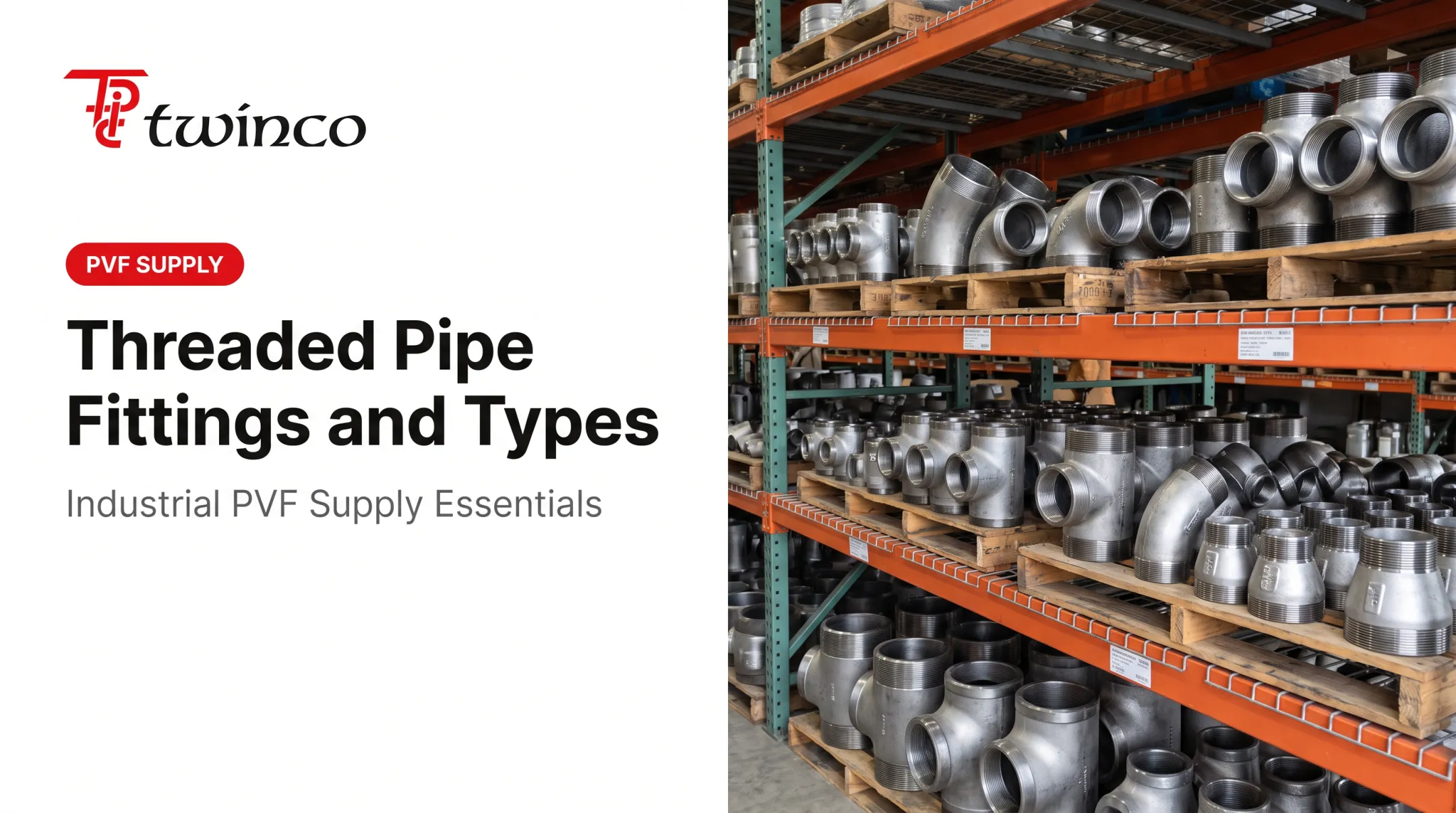
- Elbows and tees change direction and create branches
- Reducers step the pipe diameter up or down
- Flanges, gaskets, and bolting create a bolted, sealed joint
- Isolation valves shut the section off for maintenance or testing
When components don't match, the consequences show up fast. According to NIST's industrial flow-loss research, every valve and fitting adds pressure loss beyond straight-pipe friction. An oversized or wrong-pattern component drains system performance even before anything fails outright.
Beyond pressure loss, mismatched parts cause:
- Leakage at joints or seats
- Connection incompatibility that stalls installation
- Premature wear from wrong materials or trim
- Rework and delays when the wrong pattern arrives on site
Main Types of Pipe Valves
Industrial valves fall into four functional categories. The Valve Manufacturers Association treats these functions as the starting point for any valve selection decision:
- Isolation valves — full open/closed service
- Control or regulating valves — throttling
- Check valves — backflow prevention
- Pressure-relief valves — overpressure protection
Isolation Valves: Gate, Ball, Plug, and Butterfly
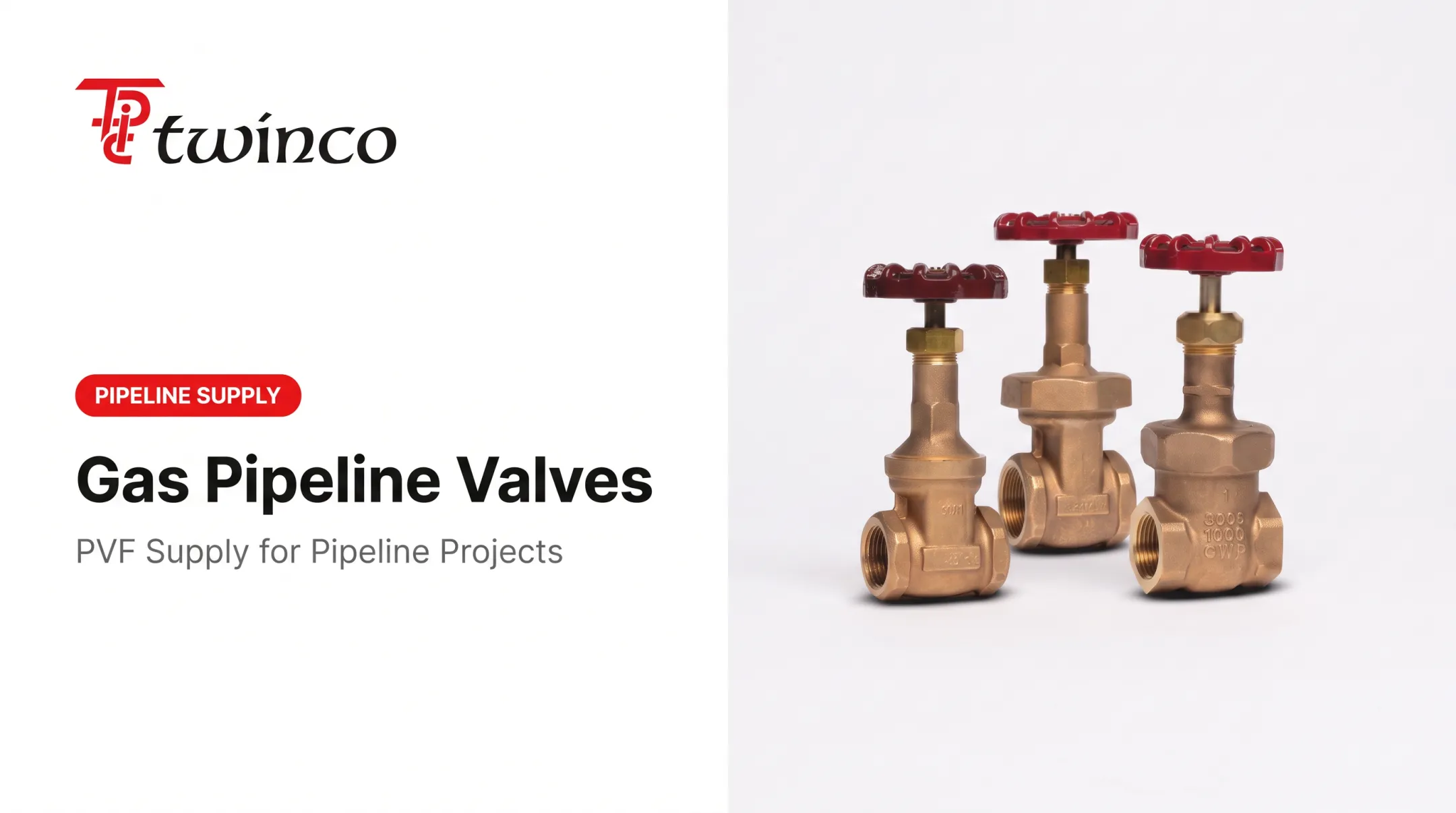
Gate valves offer a straight-through flow path, which makes them ideal for full-open or full-closed isolation. They are not the right pick for continuous throttling—the gate wears unevenly when left partially open.
Twinco stocks gate valves in rising-stem and non-rising-stem configurations: cast steel in 2"–48" and Classes 150–2500, or forged steel in ¼"–2" for high-pressure, high-temperature work.
Ball, plug, and butterfly valves are quarter-turn designs built for speed:
- Ball valves: quick, dependable shutoff with minimal pressure drop; common in emergency and high-pressure service
- Plug valves: similar quarter-turn action with sealing options suited to tougher media
- Butterfly valves: compact face-to-face length for large-diameter, lower-pressure lines
Control Valves: Globe and Needle
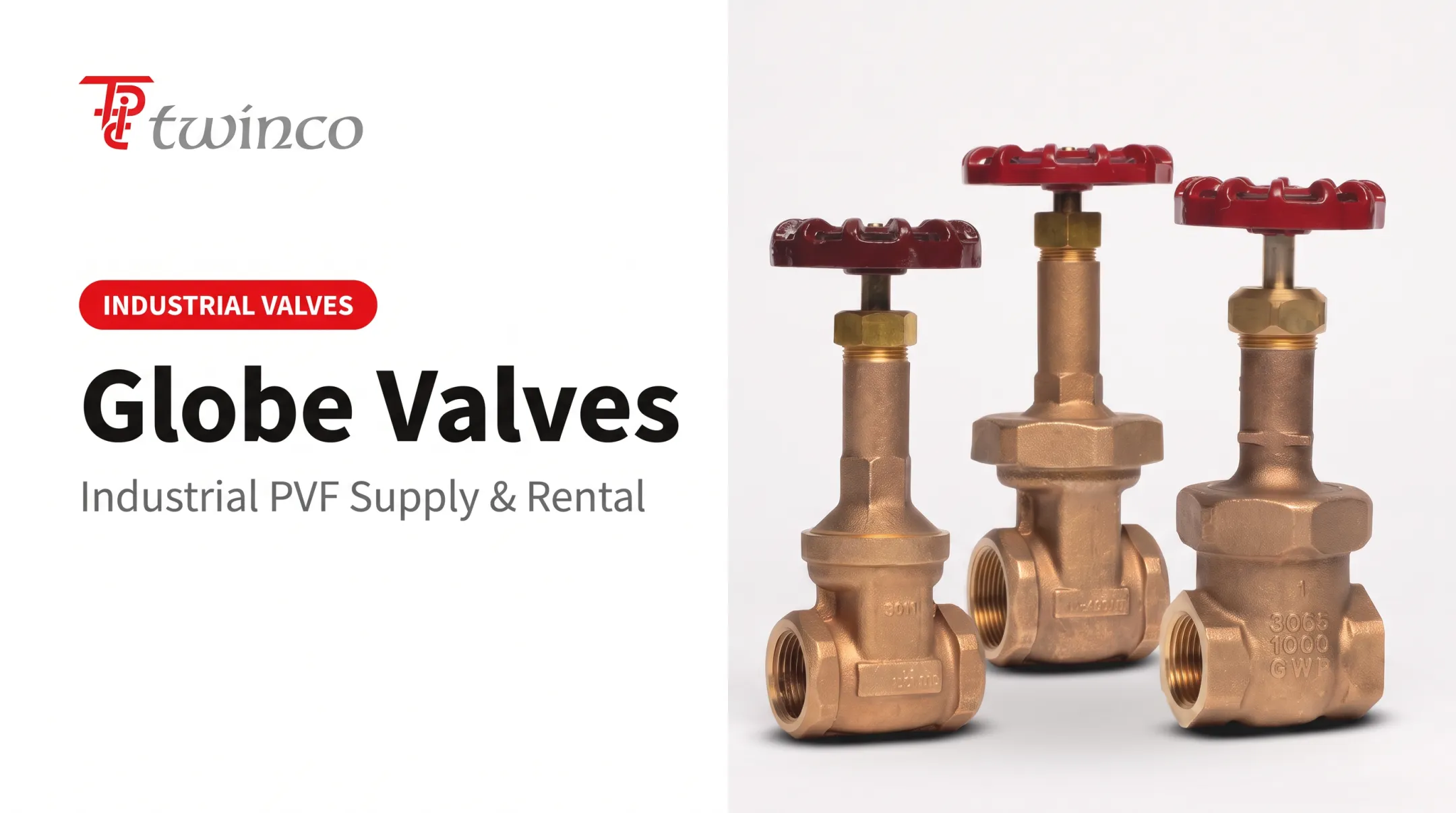
Globe valves and needle valves handle throttling duty that gate valves can't. A globe valve's plug-onto-seat design gives strong flow control, though it comes with higher pressure loss than a straight-through valve. Needle valves add fine adjustment for precise, low-flow regulation.
Check Valves and Pressure-Relief Valves
Check valves prevent reverse flow automatically, no external actuation needed. Swing, lift, and wafer designs each fit different orientations and space constraints. Pressure-relief valves serve a different role: they are automatic protective devices that open at a set pressure condition. Sizing and set points require qualified design review against the applicable vessel and piping codes.
Diaphragm and Pinch Valves
For corrosive, abrasive, or solids-laden fluids, diaphragm and pinch valves isolate the process media from the valve body itself. Always verify material, temperature, and pressure limits against manufacturer data before specifying either type.
Choosing an Actuator
Once the valve type is set, the next decision is how it will be operated. Manual actuation works fine for infrequent operation. Remote pipelines, frequent cycling, large valve sizes, or emergency shutdown scenarios usually call for pneumatic, hydraulic, or electric actuation instead. The choice depends on required response time, available utilities, and whether fail-safe positioning matters for the application.

Main Types of Pipe Fittings
Fittings do the structural work of a piping system: connecting, branching, resizing, and terminating pipe runs.
Elbows, Tees, and Branch Fittings
Elbows change flow direction. Angle, bend radius, and pipe size all affect pressure loss and should be matched to the line's flow and layout requirements. Tees, crosses, and branch fittings divide or combine flow — branch size and reinforcement need to match the piping layout, not just the nominal pipe diameter.
Reducers, Couplings, and Terminations
Concentric and eccentric reducers change pipe diameter, but orientation matters: eccentric reducers are often specified for drainage or pump suction lines where trapped air or liquid would otherwise cause problems.
Other connection and termination fittings include:
- Couplings, unions, nipples, and adapters — join sections or transition size, material, or end type
- Caps and plugs — close a line end temporarily or permanently
- Blind flanges — seal an end while allowing bolt-on access for testing or maintenance
Flanges, Gaskets, Bolting, and Connection Methods
Flanges, gaskets, and bolting function as one connected sealing system, not three separate parts. The flange rating, gasket material, bolt pattern, and tightening method all need to be compatible with each other.
Connection method depends on the job:
| Connection Type | Common Use Case |
|---|---|
| Threaded | Small-bore, lower-pressure service |
| Socket-weld | Small-bore, higher-integrity joints |
| Butt-weld | Permanent, high-pressure piping |
| Flanged | Disassembly, equipment interfaces, inspection access |
| Grooved | Fast installation, maintenance access at each joint |
Manufacturing method also affects which fitting you specify for a given pressure class and connection type:
- Forged fittings (ASME B16.11) — typically chosen for higher-pressure small-bore service
- Cast fittings (ASME B16.3, B16.4, B16.5) — cover a broader range of pressure classes and end connections
Confirm the applicable standard and material certification for the intended service before ordering.
How to Select the Right Pipe Valve or Fitting
Start with the service conditions, not the catalog. Identify:
- Fluid or gas type, corrosiveness, abrasiveness, and viscosity
- Solids content and toxicity
- Cleanliness requirements
- Hazardous-service classification
From there, match size, pressure rating, temperature rating, materials, trim, and gasket construction to the design conditions. For pipeline ball, check, gate, and plug valves, API Specification 6D defines design, manufacturing, testing, and documentation requirements. Use published standards like this instead of guessing at ratings.

Determine Function Before Design
Before picking a valve pattern or fitting type, nail down the actual job:
- Full isolation, throttling, or backflow prevention
- Pressure relief, drainage, or venting
- Branching, direction change, or diameter reduction
- Line termination
Pre-Order Checklist
Run through this before the purchase order goes out:
- Nominal size and wall thickness/schedule
- Valve pattern and face-to-face dimensions
- End connection and material
- Pressure class and flow direction
- Accessories, quantity, and required documentation
- Delivery date against your schedule
Safety-critical, high-pressure, hazardous, or pressure-relief applications need review by qualified engineers and compliance with applicable codes. No exceptions.
Common Industrial Applications for Valves and Fittings
Pipeline construction and repair projects lean on valves, flanges, fittings, gaskets, and bolting to assemble, isolate, test, and maintain lines. Refinery, petrochemical, chemical, power, and manufacturing facilities raise the bar further—material compatibility, reliable shutoff, and planned maintenance all have to hold under continuous service.
Hydrostatic testing, inspection, and turnaround work depend heavily on temporary isolation. Rental blind flanges, for instance, isolate pipelines and process systems during testing and shutdowns: sizes commonly run from ½" to 72", covering pressure classes from 125# to 2500#.

Procurement priorities in these settings include:
- Replacing failed parts mid-job without waiting on long lead times
- Sourcing hard-to-find or oversized sizes
- Matching specifications correctly on the first order
- Fulfilling orders fast enough to protect the schedule
- Minimizing stored inventory between projects
These pressures show up constantly in petrochemical plant operations, pipeline midstream work, and plant turnarounds, where a missing gasket or wrong-class flange can hold up an entire crew.
Buying Pipe Valves and Fittings for Industrial Projects
Not every supplier can back up a catalog with actual availability. Evaluate a supplier on:
- Product breadth and inventory depth
- Specialty sourcing for oversized or hard-to-find components
- Specification support and documentation
- Inspection processes and packaging
- Delivery capability against your timeline
Make the buy-versus-rent call early:
- Purchase permanent installation components (flanges, valves, and fittings going into the line)
- Rent specialized testing, isolation, or tooling equipment used for a single shutdown or turnaround
Twinco Industrial has supplied industrial and energy projects across the US, Canada, and Mexico since 1977. The company pairs deep stock of pipe, valves, fittings, flanges, gaskets, and bolting with rental solutions for hydraulic tools, blind flanges, and chart recorders.
Twinco is based in Houston with rapid fulfillment across the Gulf Coast and nationwide shipping.
For time-sensitive, oversized, specialty, or hard-to-find components, reach out to Twinco's inside sales team to confirm specs before you order. They're available 24/7 for emergency response, including nights and weekends.
Frequently Asked Questions
What is a pipe valve?
A pipe valve is a mechanical device installed in a piping system to start, stop, regulate, redirect, or automatically control fluid flow. It's the primary tool for managing what happens inside a line, as opposed to how the line is physically connected.
What are the main types of pipe valves?
Major types include gate, globe, ball, butterfly, plug, check, needle, diaphragm, pinch, and pressure-relief valves. Each serves a different function, from full isolation to fine throttling to backflow prevention.
What is a pressure release valve pipe?
A pressure-relief valve is installed in a piping system to protect against excessive pressure by opening automatically at a set pressure. Sizing and set points require review by a qualified engineer against applicable codes.
What are fittings and valves?
Valves control or stop flow using a moving mechanism inside the device. Fittings connect and configure pipe sections, changing direction, diameter, or branching without any moving parts.
What are the different types of pipe fittings?
Common types include elbows, tees, reducers, couplings, unions, adapters, caps, plugs, and flanges. Each handles a specific job, from changing direction to terminating a line to joining two pipe sections.
What are NVR valves and fittings?
NVR commonly refers to non-return valves, which prevent reverse flow in a piping system. Terminology varies by supplier, so confirm the exact valve design and abbreviation your project specification requires before ordering.