Introduction
Reverse flow is one of the fastest ways to damage a pump, wreck a compressor, or send a pressure surge through a piping system. Backflow can spin a pump backward, contaminate a clean line, or trigger water hammer that stresses welds and supports.
A swing check valve is one of the most common tools engineers use to stop that from happening. It's an automatic, non-return valve that opens with forward flow and closes on its own when flow stops or reverses. No actuator or operator is required.
This guide covers how swing check valves work, the main design variations, where they fit best, and how to install and maintain them correctly. We'll also flag when a swing check isn't the right call.
The correct valve for your line depends on fluid type, pressure, temperature, flow behavior, piping orientation, and how fast the valve needs to close.
Key Takeaways
- Hinged disc opens with forward flow and swings shut when flow stops or reverses.
- Low restriction and passive operation suit steady flow—not rapid reverse or pulsating service.
- Install to the flow arrow and manufacturer orientation limits; confirm both before startup.
- Select by size, pressure class, materials, connections, water hammer risk, and seating speed.
What Is a Swing Check Valve and How Does It Work?
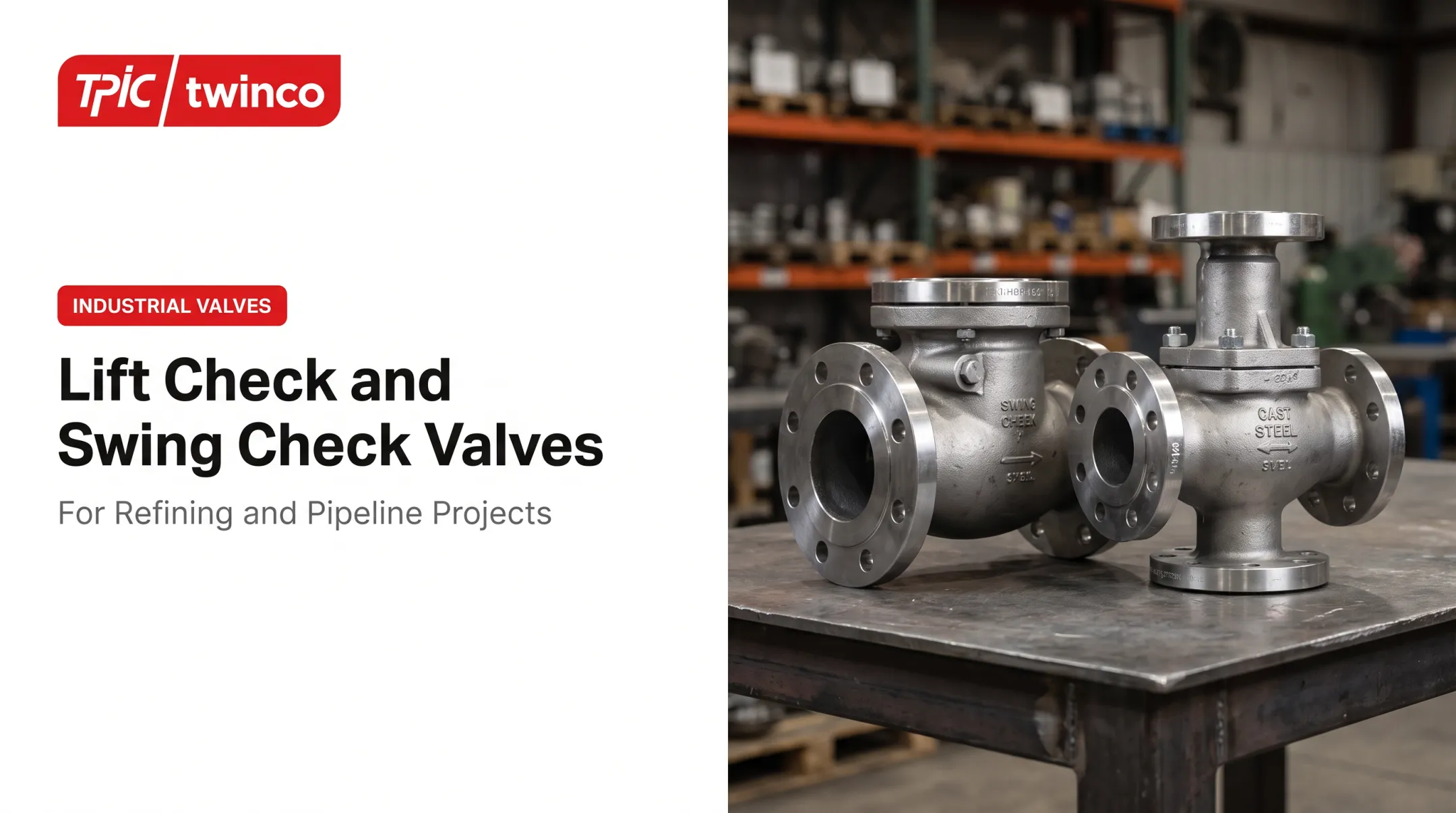
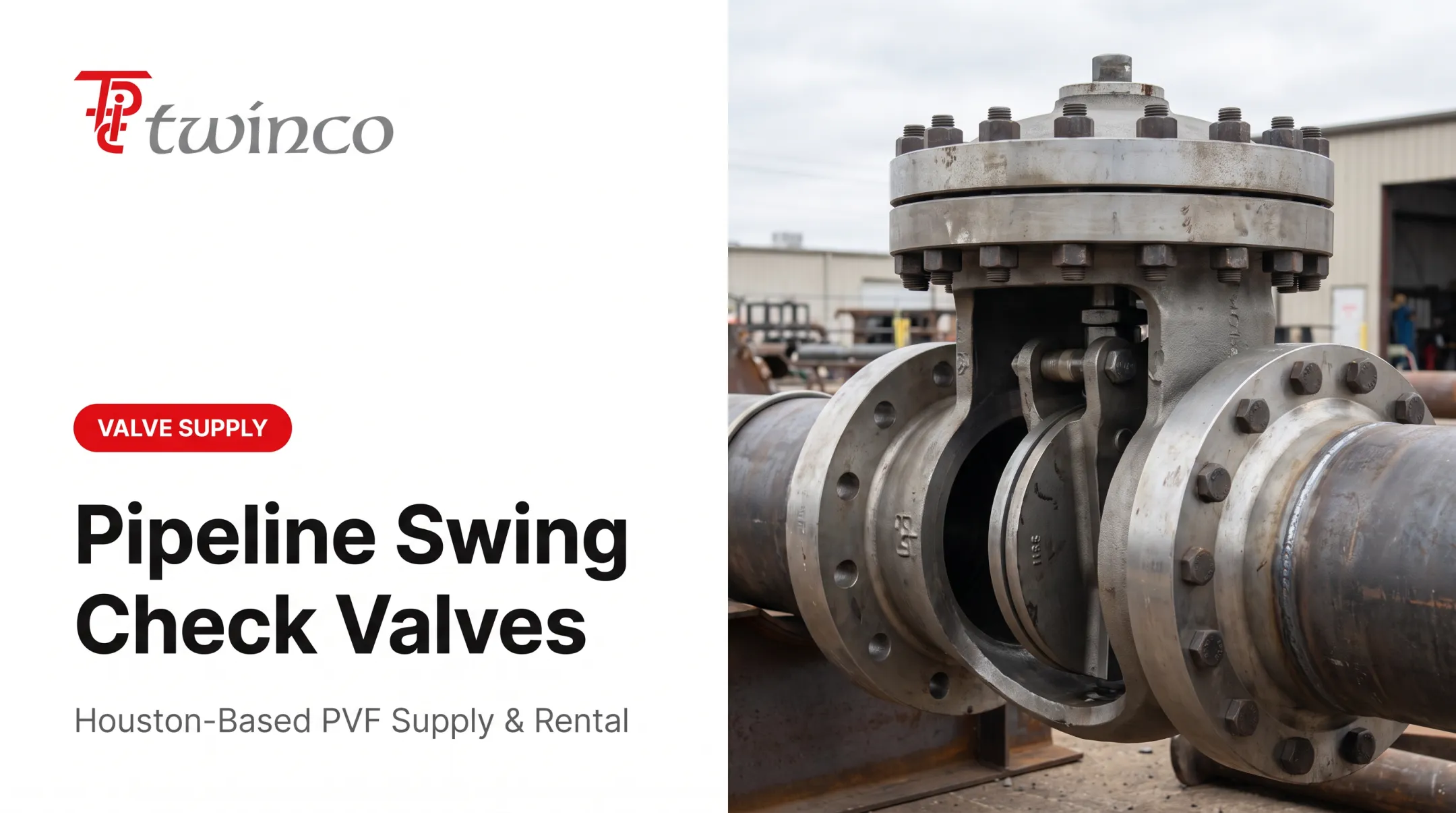
"Check valve" is the broad category covering any valve that prevents reverse flow automatically. "Swing" describes a specific mechanism within that category: a hinged disc that pivots on a shaft or hinge pin, swinging away from the seat during forward flow and swinging back to seal against it when flow stops.
Main components include:
- Valve body and bonnet or cover
- Seat (the sealing surface the disc closes against)
- Hinged disc or flap
- Hinge pin or shaft
- Flow passage
Keep a manufacturer's cutaway drawing nearby when reviewing internals. Disc geometry varies between models.
How the Disc Moves
The operating sequence is straightforward:
- Forward flow — differential pressure pushes the disc off the seat, letting fluid pass with minimal restriction.
- Flow stops or reverses — gravity and reverse differential pressure swing the disc back toward the seat, blocking backflow.
Crane's technical documentation notes that a properly functioning check valve typically needs no external signal or power source to operate. It responds purely to pressure conditions in the line.
That same passive design ties disc behavior to fluid velocity, valve orientation, and how quickly system pressure changes. A line running near minimum velocity may not hold the disc fully open, while a sudden pressure drop can slam the disc shut hard.

Swing Check Valves vs. Certified Backflow Preventers
Here's a distinction that gets glossed over often: a swing check valve prevents reverse flow, but that's not the same as being a certified backflow prevention assembly. Regulated backflow preventers go through specific testing and listing processes for potable water and cross-connection control applications.
A swing check valve shouldn't be treated as a substitute unless the specific product carries that certification. If your application requires certified backflow protection, confirm the listing on the actual product, not the valve category.
Swing Check Valve Types and Selection Criteria
Not all swing checks are built the same. The two most common body patterns are T-pattern and Y-pattern—and each trades flow capacity against maintenance access.
T-Pattern vs. Y-Pattern
According to Milwaukee Valve's technical comparison, both patterns provide backflow protection, but they trade off differently:
| Factor | T-Pattern | Y-Pattern |
|---|---|---|
| Flow capacity | Higher — can be roughly double a comparable Y-pattern in some sizes | Lower, due to angled seat |
| Maintenance access | Requires more clearance to remove cover | Angled seat allows in-line grinding, machining, or polishing |
| Typical use | Higher-flow lines where capacity matters most | Lines needing easier in-place seat repair |
Choose T-pattern when throughput is the priority; choose Y-pattern when you need easier in-place seat work.
Specifications to Confirm Before Ordering
Before requesting a quote, have these details ready:
- Nominal pipe size and end connection type
- Pressure class or rating and applicable standards (ASME B16.34, API 594, AWWA C508, etc.)
- Body, trim, and seat materials
- Temperature and pressure range
- Fluid type, viscosity, solids content, and corrosiveness
- Normal flow rate and the consequences if reverse flow occurs
- Flow direction and installation orientation
- Delivery timeline
When a Swing Check Fits — and When It Doesn't
Swing checks work well in relatively steady-flow systems where a simple, passive mechanism is the priority. Flowserve's selection guide notes that the straight-through design and clear waterway keep pressure drop low compared to more restrictive valve types.
Swing checks tend to struggle in:
- Systems with rapid flow reversal
- Vertical upward installations without adequate design accommodation
- Pulsating flow that causes repeated disc movement
- Applications needing minimal disc travel for fast closure
In those cases, evaluate a spring-loaded check valve. Spring-assisted designs close before flow fully reverses, which can reduce or eliminate water hammer risk. They typically install in more orientations, with the tradeoff of higher pressure drop and different maintenance needs.

Neither design wins across the board. Match the choice to your flow profile, orientation limits, and how much pressure drop you can tolerate.
Twinco Industrial can help confirm valve specs and check availability before you place an order—especially on pipeline, petrochemical, and industrial service requirements.
Applications and Benefits of Swing Check Valves
Swing check valves serve a wide range of industrial piping systems, each with its own engineering demands:
- Pipeline and petrochemical process lines — protecting against backflow in transmission and processing systems
- Pump discharge piping — preventing reverse rotation and protecting the pump when it shuts down
- Power generation — supporting boiler feedwater and process piping
- Water and wastewater systems — municipal and industrial applications, often built to AWWA C508
- Fire protection — select UL-listed, FM-approved models rated for fire service
- HVAC and general industrial manufacturing — process and utility piping
Each of these applications carries its own code requirements and operating conditions, so the specific standard a valve needs to meet (API 594, AWWA C508, or otherwise) depends on where it's installed.
Key benefits:
- Automatic operation with no actuator needed for normal service
- Simple construction with fewer moving parts to maintain
- Dependable reverse-flow protection in steady flow service
- Straightforward disc and seat access on cover-access designs
Those same services often need matching valves and PVF on tight schedules. Twinco Industrial stocks swing check valves from 2 inches through 60 inches, in Classes 150 through 2500, for pipeline, petrochemical, and energy infrastructure work. That inventory supports maintenance, turnaround, construction, testing, and emergency procurement—often alongside the flanges, fittings, gaskets, and bolting those jobs require.
Installation, Maintenance, and Common Operating Problems
Getting a swing check valve into service correctly matters as much as picking the right one. Solid installation, clean commissioning, and a simple maintenance cadence prevent most chatter, leakage, and early wear.
Installation Essentials
- Confirm the flow arrow on the valve body matches actual process flow direction.
- Verify whether the model is rated for horizontal, vertical-upward, or other approved orientations — don't assume.
- Install in a properly aligned, adequately supported line with clearance to remove the cover for inspection.
- Follow the manufacturer's straight-run guidance near elbows, reducers, pumps, and strainers.
Valve Magazine's coverage of check valve chatter points to turbulence from tight installations near pumps or elbows as a common root cause of instability. Manufacturer guidance often calls for several pipe diameters of straight run upstream and downstream to avoid this.
Commissioning and Inspection
Before startup:
- Check flange or threaded connections for proper torque and alignment.
- Confirm the disc moves freely when inspection access allows.
- Remove all construction debris from the line.
- Verify the valve closes fully without binding.
Diagnosing Common Symptoms
| Symptom | Likely Causes |
|---|---|
| Downstream pressure loss or reduced flow | Incorrect sizing, obstruction, excessive turbulence, disc not fully opening |
| Reverse leakage | Seat damage, debris, corrosion, disc misalignment |
| Chatter, banging, repeated cycling | Unstable flow, incorrect sizing, excessive velocity, need for faster-closing valve |
Don't diagnose by sound alone. Chatter and banging can share several root causes, and treating the wrong one usually means the wrong fix. Confirm sizing, orientation, straight-run, and seat condition before you change the valve.

Ongoing Maintenance
- Inspect on a schedule matched to service severity
- Clean internals where the design allows access
- Check seats and hinges for wear or corrosion
- Replace damaged parts per the manufacturer's instructions
Safety note: Any inspection, removal, or repair work must happen only after the line is isolated, depressurized, and drained or purged as required, under your site's lockout/tagout and process-safety procedures.
Frequently Asked Questions
When should you use a swing check valve?
Swing check valves suit steady-flow systems that need passive, automatic reverse-flow protection. Evaluate fluid behavior, orientation, closure speed, and project specs case by case before you specify one.
Where should a swing check valve be installed?
Most swing checks go in horizontal lines; vertical service is usually limited to upward flow only. Align the flow arrow with process flow, follow the manufacturer’s limits, and leave access for inspection.
What is another name for a swing check valve?
It's commonly called a non-return valve or swing non-return valve. Terminology can vary by region, industry, and supplier, so confirm what a spec sheet means before ordering.
What is the difference between a check valve and a swing check valve?
"Check valve" is the general category for any valve that prevents reverse flow automatically. A swing check valve is one specific type within that category, using a hinged disc that swings open with forward flow.
Which is better, a swing check valve or a spring check valve?
Neither is universally better. Choose based on closure speed, orientation limits, pressure drop, water hammer risk, and your system’s real flow and fluid conditions.