Introduction
Pipeline crews, plant maintenance teams, and procurement managers face the same question on almost every valve order: full port or standard port? The answer isn't cosmetic.
It affects flow resistance, pressure drop, installation space, cleaning requirements, and how much the valve costs upfront.
Get it wrong, and you could end up with a pigging line that won't pass a pig, or a compact isolation valve that's oversized (and overpriced) for the job.
"Full port" and "full bore" describe the same design: an internal opening that closely matches the pipe's inside diameter. "Standard port" and "reduced port" describe a smaller passage. Neither term signals better or worse quality — they signal different trade-offs.
This guide breaks down those trade-offs so you can match the valve to the application, not the other way around.
Key Takeaways
- Full port valves have a bore close to the pipe's inside diameter; standard port valves use a smaller passage
- Choose full port for pigging, high flow, viscous or solids-bearing media, and pressure-drop-sensitive systems
- Standard port valves are typically more compact and economical for moderate-flow, space-limited applications
- Base selection on flow rate, allowable pressure drop, media, cleaning method, ratings, and total project cost
Full Port Ball Valves vs Standard Port Ball Valves: Quick Comparison
Side by side, full port and standard port ball valves differ most on bore, pressure drop, footprint, cost, and pigging compatibility. Use the snapshot below, then confirm final selection against manufacturer drawings and Cv data.
| Factor | Full Port | Standard Port |
|---|---|---|
| Bore | Matches pipe ID closely | Smaller than pipe ID |
| Flow / pressure drop | Lower restriction when open | Higher velocity and turbulence |
| Size / weight / cost | Larger, heavier, usually higher price | Smaller, lighter, often lower price |
| Best fit | Pigging, high throughput, viscous or solids-bearing service | General isolation, moderate flow, tight spaces |
| Cleaning / pigging | Supports continuous-bore pigging | Can block or complicate pig passage |
Bore Size
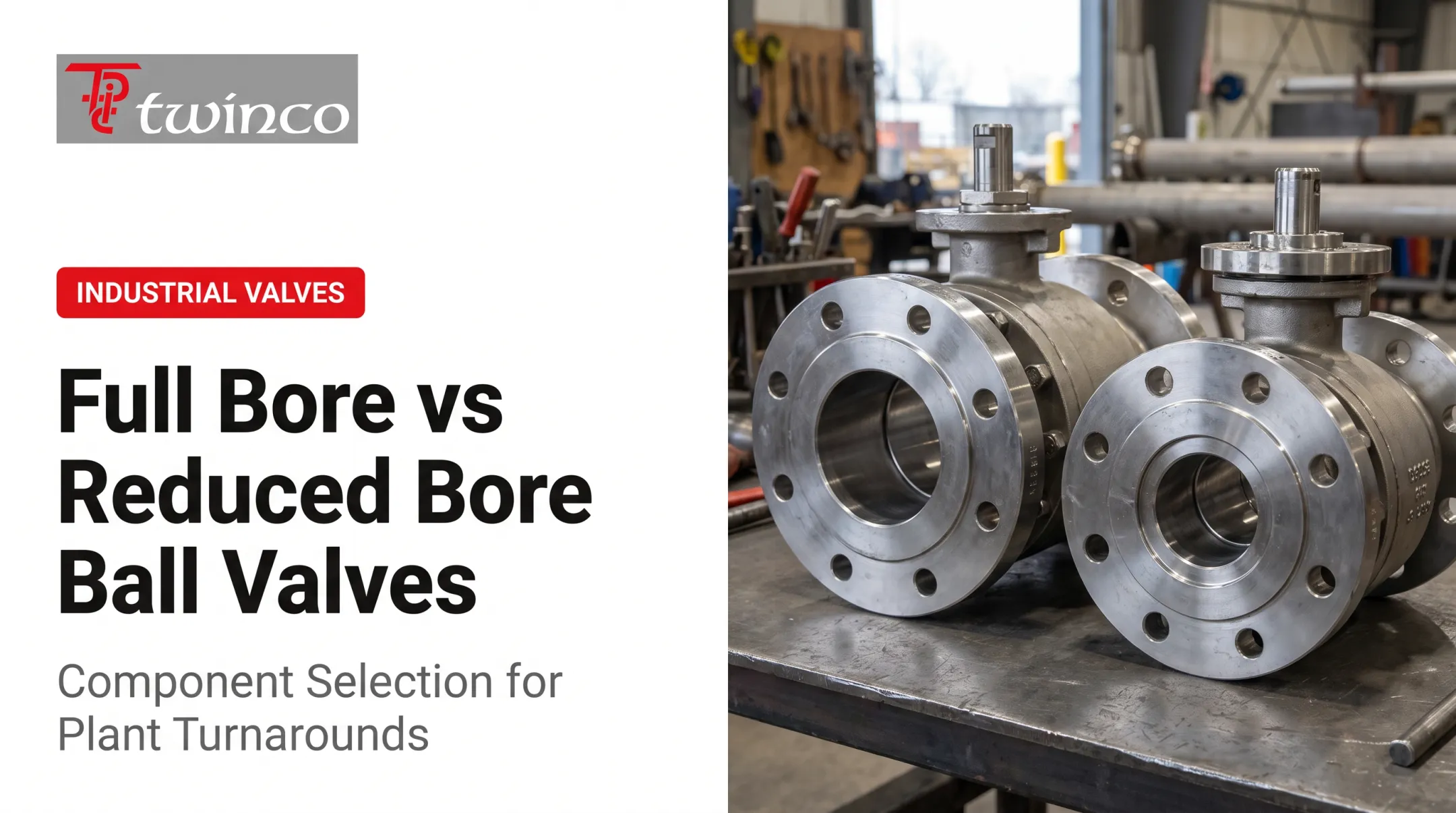
A full port ball valve's opening is machined to closely match the connected pipe's internal diameter, so the step-down between pipe and valve stays minimal. A standard port opening is smaller than the pipe ID, even when the end connections share the same nominal pipe size.
Don't assume a fixed bore relationship between the two designs. Always confirm exact dimensions on the manufacturer's dimensional drawing before specifying or substituting.
Flow Resistance and Pressure Drop
At the same nominal size and flow rate, a standard port's smaller flow area raises local velocity and turbulence. That creates more resistance than an equivalent full port valve under the same conditions.
Full port valves generally give a straighter path with less restriction when fully open. Actual pressure drop still depends on:
- Valve size and internal geometry
- Fluid density and viscosity
- Flow rate and operating temperature
- Upstream and downstream piping configuration
Manufacturer Cv data matters more than assumptions here. Balon's flow coefficient data for full bore valves notes that at very low pressure drops, standard Cv testing isn't reliable — the company recommends treating the valve as an equivalent length of pipe for system-loss calculations instead.
Cost and Physical Size
The larger bore and body of a full port valve usually mean more material, more weight, and more installation space — and a higher purchase price. Standard port valves trade some flow capacity for a smaller, lighter, often less expensive package.
Neither is automatically the better value. It depends on whether your system needs the extra flow area.
Typical Applications
Full port valves tend to get specified for:
- Piggable pipelines
- High-throughput transfer service
- Viscous fluids or solids-bearing media
- Hydrocarbon transfer where pressure loss is tightly budgeted
Standard port valves commonly work for:
- General shutoff and isolation service
- Moderate-flow piping
- Space-constrained installations
- Temporary systems and cost-sensitive projects
Cleaning and Maintenance Implications
A continuous bore supports line cleaning and pigging with fewer flow obstructions, provided the rest of the pipeline design cooperates. A reduced passage can block or complicate pig passage entirely — a real issue during flushing, cleaning, and turnaround planning, even when the valve matches the pipe's nominal connection size.

What Are Full Port and Standard Port Ball Valves?
Full Port Ball Valves
A ball valve is a quarter-turn isolation device: a rotating ball with a central opening controls flow through the body. "Full port" refers specifically to the size of that opening: it's designed to closely match the pipe's inside diameter.
The near-continuous bore reduces restriction when the valve is fully open. That said, full port ball valves are built for on/off isolation, not continuous throttling. Trying to use one as a flow-control device introduces problems we'll cover below.
In practice, the full port design supports:
- Maintaining throughput without an artificial choke point
- Limiting avoidable pressure loss across the valve
- Passing pigs during line cleaning or inspection runs
- Avoiding restrictions that interfere with testing or transfer operations
Full port is the better fit for piggable pipelines, high flow rates, viscous fluids, solids-bearing media, and systems with a strict pressure-drop budget.
Standard Port Ball Valves
Standard port — also called reduced port — describes a ball valve whose internal opening is smaller than the connected pipe's internal diameter. That's a design choice, not a quality shortfall.
The trade-off is straightforward: a smaller passage can reduce valve size, weight, and purchase cost, but it increases restriction, velocity, and turbulence compared to a full port valve under similar conditions.
Standard port valves are a practical fit for:
- General shutoff where unrestricted flow isn't required
- Moderate-flow, non-piggable systems
- Limited installation space
- Temporary piping setups
- Projects where the engineering team has confirmed the pressure loss is acceptable
Standard port valves show up constantly across refinery, plant, and construction work — as long as pressure class, materials, temperature rating, and end connections are correctly specified for the service.
One caution applies to both port types: ball valves shouldn't normally be used for throttling unless the manufacturer and engineer approve that specific duty. Emerson notes that isolation valves are typically designed to operate fully open or fully closed, while purpose-built throttling ball valves are a separate product category engineered for that duty.
Partial opening on a standard isolation ball valve can increase turbulence, accelerate seat wear, and cause damage over time.
Use Cases Across Industrial Projects
Pipeline construction and hydrostatic testing often prioritize bore continuity and cleaning performance differently than routine plant isolation does. A pigging line has different requirements than a simple bypass valve.
Refinery, petrochemical, power, and industrial maintenance teams should weigh each valve against:
- Piping specification and material compatibility
- Pressure and temperature conditions
- Shutoff requirements
- Turnaround schedule
EPC and engineering teams can avoid costly downstream substitutions by locking in port type, material, pressure class, end connection, actuation, and testing requirements directly in the material take-off, not left to interpretation later in the project.
Full Port vs Standard Port: What Is Better?
Neither design wins universally. Full port is usually the stronger choice when flow continuity, pigging, solids handling, or low pressure drop is critical. Standard port often makes more sense when compactness and upfront cost matter more than maximum flow area.

A Practical Selection Checklist
Before specifying either type, confirm:
- Fluid or gas properties: viscosity, solids content, corrosiveness
- Required flow rate and allowable pressure drop for the system
- Cleaning or pigging requirements, including pig type and bidirectional needs
- Pressure and temperature ratings for the full operating range
- Corrosion compatibility with the valve's materials
- Available installation space and end-to-end dimensions
- Actuation method and applicable industry standards (API 6D, ASME B16.34, MSS SP-110)
Compare More Than Purchase Price
The cheaper valve on paper isn't always cheaper over the project's life. Weigh initial cost against:
- Pump or compressor demand created by added restriction
- Throughput requirements over the equipment's service life
- Cleaning and maintenance procedures
- Wear and maintenance access
- Replacement part availability
- The cost of a project delay if the wrong valve shows up
Always verify manufacturer dimensional drawings, bore data, Cv or flow figures, pressure-temperature ratings, materials, and seat construction before approving a substitute, especially when a supplier proposes a like-for-like swap based on nominal size alone.
Situational Recommendations
- Choose full port when the line must be pigged, the media is viscous or solids-bearing, the process is pressure-drop sensitive, or maximum flow capacity matters.
- Choose standard port when the service is primarily isolation, flow demand is moderate, space is tight, and engineering has confirmed the restriction won't affect equipment performance.
- Escalate to a qualified engineer whenever the valve sits in a high-pressure, high-temperature, hazardous, or regulated system.
Per API 6D's specification for pipeline valves, full-opening through-conduit valves must pass a sphere of specified nominal size. Reduced-opening valves generally aren't suitable for most pigging operations, including intelligent pigging. If piggability is a requirement, put that distinction in your purchase spec rather than leaving it to assumption.
Real-World Selection Examples
Pipeline Transfer Scenario
A midstream operator running a piggable transfer line needs to protect throughput and keep pressure loss within a tight budget. Here, a full port valve gets evaluated first. The decision should rest on the manufacturer's bore data, Cv figures, and confirmed piggability — not the nominal size alone.
Plant Maintenance and Testing Scenario
A refinery turnaround crew needs a temporary isolation valve for a hydrostatic test setup. Space is limited, the run is short-term, and unrestricted flow isn't the priority. A standard port valve can work well here, once pressure-drop and material compatibility are confirmed for the test conditions.

Procurement takeaway: Confirm port type and full specifications before ordering, especially when replacing an existing valve with the same nominal connection size. A matching end connection doesn't guarantee a matching bore.
Twinco Industrial supports pipeline, petrochemical, and construction teams across the US with ball valves in full-port, standard-port, and high-pressure configurations, alongside the flanges, fittings, and rental equipment that surround them.
When you request a quote, include:
- Size and pressure class
- Material and end connection
- Media, quantity, and required delivery date
That detail speeds up getting the right valve on your job site.
Conclusion
Full port ball valves prioritize an open flow path: the right call for pigging, high flow, viscous or solids-bearing service, and systems where every bit of pressure drop counts.
Standard port valves prioritize compactness and cost, which fits general isolation work where some restriction is acceptable.
The correct choice depends on the complete application, not the label on the valve. Before you buy, check your project specs against:
- Flow data and allowable pressure drop
- Pressure and temperature ratings
- Materials and dimensions
- Cleaning or pigging requirements
Twinco Industrial has supplied pipeline, petrochemical, construction, testing, and maintenance teams across the US since 1977. Whether you need a full port valve for a piggable line or a standard port valve for a compact isolation job, reach out with your specs and Twinco's team can help you source the right valve on your schedule.
Frequently Asked Questions
What does "full port" mean on a valve?
A full port valve has an internal bore that closely matches the connected pipe's inside diameter, reducing flow restriction when fully open. "Full bore" is commonly used as an equivalent term.
What is the difference between a full port and a reduced port ball valve?
Full port valves have a larger internal opening, lower flow resistance, and typically a larger body and higher cost. Reduced port valves have a smaller opening, higher resistance, and a more compact, economical design. Check manufacturer Cv data for exact performance figures.
What does "full bore" mean in valves?
Full bore means the valve's internal passage is approximately the same diameter as the pipe's internal flow path. Confirm exact dimensions in the manufacturer's drawings, since bore size varies by model and pressure class.
When should you use a full bore valve?
Use a full bore valve for piggable pipelines, high flow rates, viscous or solids-bearing media, and cleaning requirements where pressure drop must stay minimal. Always check the complete system design before finalizing the choice.
What is a 3-piece full port ball valve?
A 3-piece full port ball valve is built from a body and two end sections, so seats and seals are accessible without removing the whole valve from the line. Pressure class, materials, and connection type vary by manufacturer.
What are the standard sizes of ball valves?
Ball valves are manufactured across a wide range of nominal pipe sizes, and "standard size" usually refers to the connection size, not the internal bore. Confirm the required size, schedule, end connection, and port type against your piping specification before ordering.