Introduction
Valves fail. Not always catastrophically, but often enough that relying on a closed valve as your only barrier during maintenance, testing, or hazardous-service work is a gamble. The U.S. Chemical Safety Board has flagged this directly: closing valves is considered the least effective isolation method because valves can leak, compared to blocking and bleeding, inserting a blind, or physically disconnecting the line (CSB, 2017).
That's where the spectacle blind flange comes in. Shaped like a figure eight, it pairs one solid disc for isolation with one open ring for flow, bolted between mating pipe flanges. Rotate it one way, and the line runs. Rotate it the other, and the line is physically blocked.
This guide covers:
- How spectacle blinds work and where they fit in piping systems
- How they compare to spades and ring spacers
- Selection criteria, installation safety, and sourcing for US projects
Key Takeaways
- Rotating the solid or open side switches the line between isolation and flow, but only under an approved procedure.
- Size, pressure class, material, facing, gasket, and bolting must all match the piping specification.
- ASME B16.48 governs many US line blanks, but your project spec and applicable code still take priority.
- Twinco Industrial supplies and rents spectacle blinds, bolting, gaskets, and test gear to limit project downtime.
What Is a Spectacle Blind Flange and How Does It Work?
A spectacle blind, also called a figure-eight blind or line blank, gets its name from its shape: two circular sections joined by a web or handle, resembling a pair of eyeglasses. One side is a solid plate. The other is an open ring, or spacer.
Two Positions, One Purpose
The device has exactly two operating states:
- Flow position: The open ring aligns with the pipe bore so product flows normally; the solid plate sits outside the path as a visible status indicator.
- Isolation position: The solid plate sits between the flanges, creating a physical barrier that stops flow completely.
Anyone walking the line can see, at a glance, which state the blind is in. That visual confirmation is part of why plants use them over valves alone.
The Changeover Process
Switching a spectacle blind isn't a quick flip of a lever. It follows a defined sequence:
- Depressurize and make the joint safe according to the approved work package.
- Loosen and manage the flange bolting.
- Rotate or reposition the blind to the required orientation.
- Install a new gasket (never reuse the old one).
- Retighten bolting per the specified pattern and torque.

A spectacle blind is not a flow-control valve. Do not treat it as a substitute for lockout/tagout, pressure release, gas testing, or the verification steps required before work begins.
Applications and Benefits of Spectacle Blind Flanges
Spectacle blinds show up wherever a piping section needs to move between "in service" and "positively isolated" on a repeatable basis. Common settings include:
- Pipeline and pump station isolation points
- Refinery and petrochemical unit turnarounds
- Power generation piping systems
- Hydrostatic testing setups
- Equipment maintenance and planned shutdowns
Why Plants Use Them
OSHA defines blanking or blinding as the absolute closure of a pipe or line with a solid plate. The plate must fully cover the bore and withstand the line's maximum pressure without leaking beyond it (OSHA, 2021).
A properly selected and installed spectacle blind meets that definition when the gasket, bolting, and orientation are all correct.
That's the operative benefit: a physical barrier reduces dependence on valve integrity alone. It does not eliminate every leak risk. The joint still depends on gasket condition, bolt torque, and correct blind orientation. Site procedures and engineering sign-off still govern the work.
What Limits Their Use
Spectacle blinds aren't the right fit everywhere:
- Large sizes or high pressure classes can make the assembly heavy and hard to handle
- Restricted access may leave no room to rotate the blind
- Repeated switching without proper lifting support increases handling risk
Spectacle Blinds vs. Blind Flanges, Spades, and Ring Spacers
These terms get mixed up constantly, so here's the distinction that matters on a job site.
A standard blind flange is a single solid flange, bolted on to terminate or permanently block a connection. It doesn't switch back to flow. You'd have to remove it entirely.
A spectacle blind combines a solid plate and an open spacer in one figure-eight unit, giving you selectable isolation or flow without swapping parts.
Spades and ring spacers are the same two functions, just separated into individual pieces. A spade (or paddle blank) blocks the line. A ring spacer maintains flange spacing and permits flow.
These are useful where a figure-eight can't physically rotate due to tight clearance.
| Feature | Spectacle Blind | Spade + Ring Spacer |
|---|---|---|
| Configuration | One connected unit | Two separate pieces |
| Changeover | Rotate in place | Swap pieces manually |
| Clearance needed | Rotation radius required | Minimal — no rotation |
| Handling | Heavier, one assembly | Lighter individual pieces |
| Visual status check | Built-in via handle position | Requires checking which piece is installed |
| Best-fit use case | Frequent switching, adequate clearance | Tight spaces, infrequent switching |
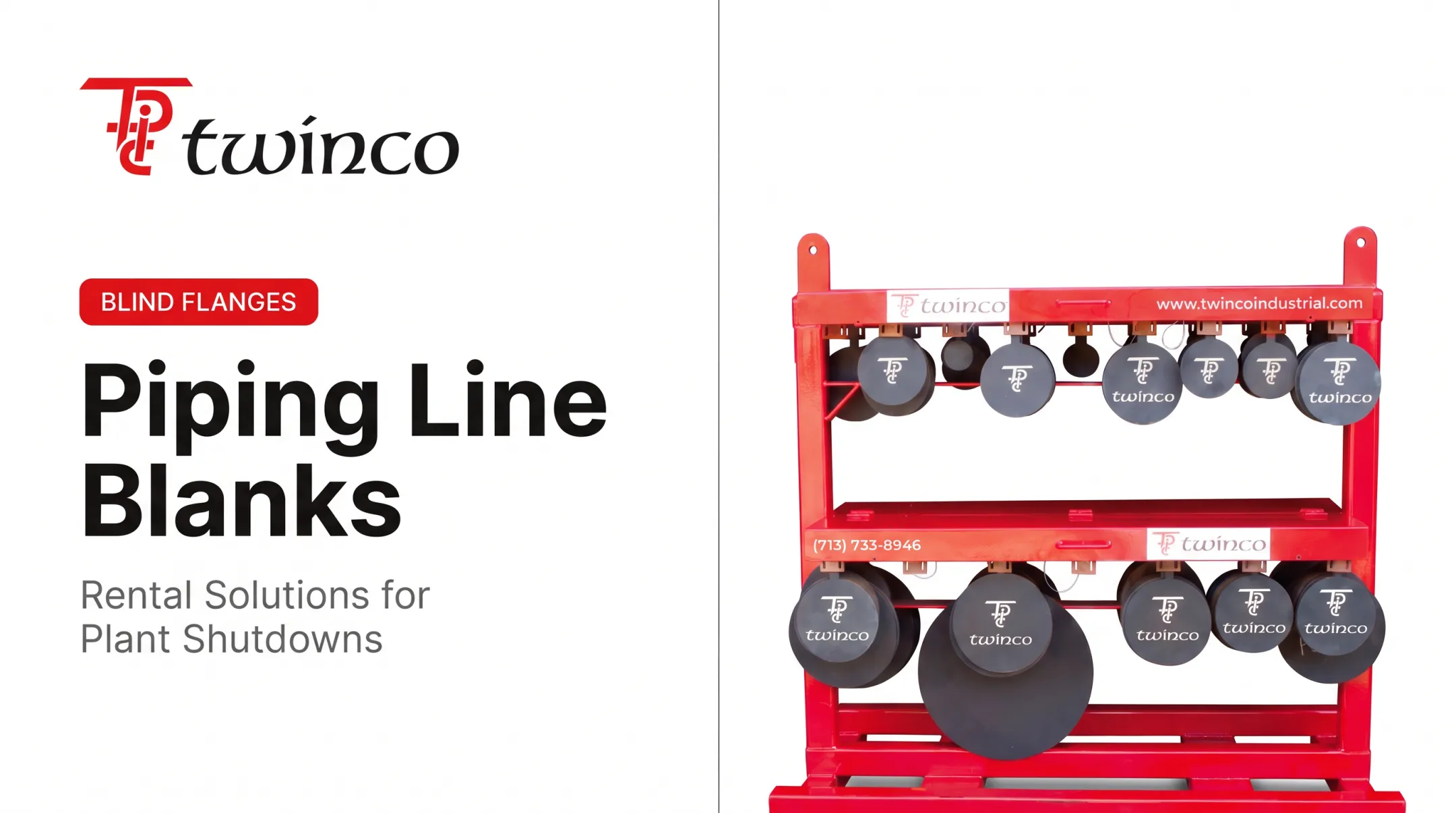
Twinco stocks both configurations, spectacle blinds and spade-and-spacer sets, and rents paddle-blind racks for organized storage and easier field handling of either type.
How to Select a Spectacle Blind Flange for Piping
Selection starts with your piping specification, not a catalog page.
Match the Piping Spec First
Confirm before ordering anything:
- Nominal pipe size and flange standard (ASME B16.5 or B16.47 for larger diameters)
- Pressure class and design temperature/pressure
- Service fluid and corrosion requirements
- Any project or owner-specific standards
ASME B16.48 covers pressure-temperature ratings, materials, dimensions, and marking for line blanks from NPS ½ through NPS 24, across Classes 150 through 2500 (ASME B16.48, 2025). It's a key reference, but your project spec and governing code remain controlling.

Material and Facing Must Match
Material selection depends on compatibility with the process medium, temperature, and mating flanges. Common grades called out in piping specs include:
- ASTM A105 for carbon steel forgings
- ASTM A182 for alloy and stainless forgings
- ASTM A350 for low-temperature service that needs notch toughness
Don't assume a grade — verify it against your design and purchasing spec.
Facing matters just as much. Match the blind to the mating flange:
- Flat face (FF) for flat-face mates
- Raised face (RF) for most general-service joints
- Ring-type joint (RTJ) for higher-pressure service
- Seal ring groove (SRG) where the joint spec calls for it
The blind's sealing surface and gasket must match the mating flange facing exactly. Twinco's rental blind flanges are available with RF, RTJ, and SRG facing options.
Site Factors and Procurement Checklist
Beyond the spec sheet, check:
- Is there enough clearance to rotate the blind?
- What's the assembly weight, and is lifting equipment available?
- How often will the blind switch positions?
- Would a spade-and-spacer set be safer given access constraints?
When requesting a quote, include:
- Datasheet or drawing
- Pressure class and face type
- Dimensions, gasket, and bolting requirements
- Quantity and required lead time
- Purchase vs. rental
Spectacle Blind Flange Installation and Safety Considerations
Installation starts long before anyone touches a bolt.
Prerequisite Controls
Before loosening any flange bolting:
- Obtain the approved work package for the isolation job.
- Isolate the system and depressurize, drain, or vent as required.
- Verify zero energy with the facility’s approved method.
- Apply lockout/tagout before any bolting is loosened.
OSHA's lockout/tagout standard requires authorized employees to verify that isolation and deenergization have actually been accomplished before work begins (OSHA 1910.147). That verification is not optional paperwork. It confirms the line is actually safe.
Preparation and Assembly
Before reassembly:
- Inspect the blind, flange faces, bolts, and gasket surfaces
- Remove debris from sealing surfaces
- Confirm the blind orientation matches the work plan. Installing it backward defeats the entire purpose
During assembly:
- Provide adequate flange separation without forcing the component
- Align bolt holes and sealing faces
- Account for the blind’s added thickness when selecting bolt length
- Tighten using the project-approved sequence and the torque or tension values specified for your service, never a guessed number
Watch for these hazards:
- Stored energy in the line
- Pinch points during rotation
- Suspended loads during handling
- Residual process chemicals
- Damaged sealing surfaces or reused gaskets
Installation, rotation, and return-to-service should be performed by qualified personnel under the facility's own procedures and applicable codes, not by generic instructions from a blog post.

Sourcing, Rental, and Procurement Checklist
When to Buy vs. Rent
Purchasing tends to make sense for recurring plant inventory, permanent piping arrangements, or sizes you use constantly. Renting is often the more efficient path for:
- Turnarounds and scheduled shutdowns
- Pressure testing programs
- Emergency repairs
- Short-duration or one-off projects
Twinco Industrial's rental blind flanges fit these jobs, especially hydrostatic testing and infrequently used sizes where ownership does not pay off.
What Twinco Offers
Twinco has supplied industrial piping components and rental equipment since 1977. Based in Houston, the company ships nationwide and supports customers across the USA, Canada, and Mexico. The inventory spans:
- Rental and purchase blind flanges, ½" through 72", Classes 125# through 2500#
- Carbon steel, stainless steel, and specialty alloy materials
- Spectacle blinds, spade-and-spacer sets, and paddle-blind racks
- Bolting, gaskets, valves, fittings, and hydraulic torquing equipment
The team specializes in oversized and hard-to-find components, and confirms size, class, material, and availability with customers before shipment.
Requesting a Quote
To get an accurate quote, provide:
- Pipe size and pressure class
- Material and face type
- Quantity needed
- Project location and required date
- Purchase or rental preference
Twinco's inside sales team, including Al Waters and Shane Holmes, confirms line size, pressure rating, and material with you before issuing a quote.
Frequently Asked Questions
What is the cost of a spectacle blind flange?
Cost depends on size, pressure class, material, face type, and buy vs. rent. Documentation and freight also affect the total—request a project-specific quote.
What is the purpose of a spectacle blind flange?
It gives a visible, physical way to switch between normal flow and positive isolation. That supports maintenance, hydrostatic testing, and shutdowns without removing pipe.
What is the difference between a flange and a blind flange?
A flange joins piping or equipment and has an open bore for flow. A blind flange is a solid bolted plate that closes off a pipe, nozzle, or connection entirely.
How do you select the right spectacle blind flange?
Match pipe size, pressure-temperature rating, material, and facing to your piping spec. Then confirm dimensional fit, rotation clearance, and gasket and bolting compatibility.
Can spectacle blind flanges be rented for testing or maintenance?
Yes, rental availability depends on size, class, material condition, and your project location and timing. Contact Twinco Industrial to confirm current inventory for your specific requirements.